This guide covers hay day beginner guide with practical steps for mobile players.
Quick answer: Start Hay Day by planting wheat constantly and selling it through the roadside shop while you save for your first production buildings. Wheat grows fast and costs nothing, so it funds early expansion better than any other crop. Join a neighborhood as soon as you can, because neighbours are how you fill gaps in building materials, and do not spend diamonds on speeding up timers you can simply wait out.
What should you do in your first days on the farm?
Plant wheat, harvest it, and replant immediately. Wheat’s short cycle means you can keep a field busy while you work through the early tutorial orders, and the crop is needed by several early recipes and animal feeds.
Use the roadside shop to sell surplus. Early on, your silo fills faster than you can use it, and selling through the shop converts crops into coins without spending them on recipes you cannot yet make.
Follow the order board rather than hoarding. Early orders ask for simple goods and pay coins and experience, which is what unlocks the buildings that make everything else possible. An order that asks for bread you cannot bake yet is a signal to work toward the bakery, not a reason to ignore the board entirely.
What you upgrade first matters more than what you unlock first. Storage is the correct early investment, because a farm that cannot hold its output stops producing regardless of how many machines it owns. One barn upgrade and one silo upgrade will do more for your income than two new production buildings, and they cost materials rather than the coins you are saving for machines.
What you should not buy first is decoration, land expansion, or a machine whose ingredients you cannot yet supply. Each of those consumes resources that the storage upgrades need, and each of them leaves you with a farm that looks more developed without actually producing more. The order that works is storage, then the machines you can keep continuously fed, then animals, then land.
On this page
Which buildings should you unlock first?
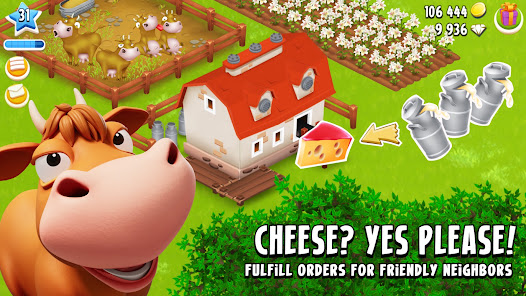
The bakery and the dairy come early and stay useful forever. Bread, cookies, cream, butter and cheese feed into dozens of later recipes, so investment in those two buildings keeps paying back.
The feed mill is just as important once you have animals. Chickens and cows produce eggs and milk only while fed, and the feed mill is what turns your crops into that feed.
Resist buying every machine the moment it unlocks. Each building needs ingredients you may not be growing yet, and an idle machine is a coin sink that also occupies space you will want later. A machine you cannot keep supplied is worse than no machine, because it draws attention away from the ones that are actually earning.
| Priority | Building | Why it comes early |
|---|---|---|
| 1 | Bakery | Simple goods that feed many later recipes |
| 2 | Dairy | Milk products used across the game |
| 3 | Feed mill | Turns crops into animal feed |
| 4 | Sugar mill | Unlocks the baking chain properly |
| 5 | Jam maker | High-value goods from fruit |
Treat coins as capacity rather than as a score. Every coin spent on a machine, an animal, or an upgrade increases what you can produce tomorrow; coins spent on decoration produce nothing. That single principle resolves most early purchase decisions, because it tells you to buy the thing that produces rather than the thing that looks finished.
Diamonds deserve even more restraint. They are slow to earn and they are the only way to fill a specific material gap when an upgrade is otherwise ready. Spending them on a timer you could simply wait out converts a renewable resource into a few hours, which is almost always a poor exchange. Hold them until a missing bolt is the only thing between you and a storage upgrade.
How should you use coins and diamonds?
Spend coins on buildings, animals, and land. Those are permanent improvements that increase what you can make and how much you can store, which compounds over time.
Save diamonds for storage upgrades and for the moments when a missing building material is blocking progress. Diamonds are slow to earn, and burning them on speed-ups early leaves you short when something genuinely matters.
Never buy a decoration with diamonds in your first weeks. Decorations are pleasant but do not produce anything, and the same currency buys capacity that does. There is no wrong time to make the farm look better, but there is a wrong time to do it, and that time is before your storage and your production are stable.
When storage blocks production, deal with it in a fixed order. First, sell the lowest-value goods in the full store, because cheap crops are easy to replace and occupying space that a valuable product needs. Second, feed crops into animals and machines, which converts silo contents into barn contents and buys time on both. Third, cook anything whose recipe you can run, since that empties one store while filling the other.
Only after those three steps should you spend materials on an upgrade. Often the store is not genuinely too small; it is full of things you should have sold hours ago. Upgrading to hold more of a surplus you never move is an expensive way to postpone a selling decision, and it delays the machine you actually needed.
Why does storage keep blocking you?
The silo holds crops and the barn holds produced goods, and both fill up faster than new players expect. A full silo stops harvests, which stops everything downstream.
Selling is the pressure valve. If your silo is full, selling low-value crops through the shop is better than leaving fields unharvested, because unharvested fields produce nothing at all.
Upgrading storage requires building materials rather than coins, which is why joining a neighborhood matters so early. Neighbours can donate the specific item you are missing.
Neighbours matter most in the early game for one specific reason: they are the fastest way to obtain a building material you are missing. Orders and events give materials randomly, so a player waiting for one particular item can stall for days. A request to a neighbourhood turns that wait into a conversation, and the cost of helping others is small compared with the delay it prevents.
The other early benefit is information. Neighbours are playing the same progression, so they tend to know which machine is worth buying next and which order is a trap. Asking before spending a week of materials on the wrong building is cheaper than discovering the mistake afterwards, and most neighbourhoods are willing to answer a direct question.
How do neighbourhoods and orders fit together?
A neighborhood gives you people to trade with, and trading is how you fill the gaps that solo play creates. If you need three planks and have none, a request to neighbours solves it faster than waiting for a random drop.
Help others as well. Donating costs you little and builds the goodwill that makes your own requests successful, and helping often comes with its own rewards.
The order board and the shop then convert what you have into progress. Orders pay coins and experience; the shop pays coins at your own pace. Use both rather than relying on one.
The most expensive trap is having enough coins and not enough materials. Coins accumulate steadily from the shop and orders, so players assume they are progressing, then discover that every storage upgrade and every land expansion is gated by planks and bolts instead. The coins sit unused while the farm stalls, and the fix is to treat materials as the real currency from the first day.
Avoiding that trap means never donating or selling a material you have not yet spent on an upgrade. Keep a short list of what the next barn and silo steps require, and treat those items as reserved. Everything else can be traded freely, but the reserved list is what stands between you and the next stage of the farm.
What are the common beginner mistakes?
Planting slow crops before you have storage for them is the first. The second is buying every machine as it unlocks, which spreads your ingredients too thin to run any of them well.
The third is ignoring animals because they seem complicated. Chickens and cows are cheap to start and their products are required by many recipes, so delay costs you later.
The fourth is refusing to sell. Coins buy capacity, and capacity is what lets you keep producing, so a full silo is a bigger problem than a low price. Players who wait for the perfect price spend that time unable to harvest, which is a far larger loss than the coins they were trying to protect.
The fifth is treating the game as a sprint. Hay Day is designed around waiting, and the players who do well are the ones who queue up long production runs before closing the app rather than checking every few minutes for a single item.
A related habit is to review the order board before buying anything. If the board keeps asking for a good you cannot yet make, that is a signal about which machine to unlock next. If it is asking for goods you can already produce in surplus, the coins from those orders will fund the upgrade without any guesswork about priorities.
Finally, expect the first two weeks to feel slow and the following months to feel much faster. Nearly every bottleneck in the early game is a capacity problem, and capacity upgrades compound. The farm that feels stuck at level twenty usually becomes the farm that cannot stop producing by level forty, with no change in how it is played.
Frequently asked questions
What is the best crop to plant first?
Wheat. It grows quickly, costs nothing, and is used by early recipes and animal feed.
Should I spend diamonds on speed-ups?
Rarely. Save them for storage upgrades and missing building materials that block progress.
When should I join a neighborhood?
As early as possible. Neighbours supply building materials that solo play makes slow to obtain.
Do I need animals early?
Yes, at least chickens. Their products feed into many recipes and the setup cost is low.
Why can I not harvest my fields?
Your silo is probably full. Sell or use the stored crops to free space.
For more on the game’s systems, see the Hay Day hub.
Official game information: supercell.com.