
This guide covers simcity buildit how to provide water with practical steps for mobile players.
Quick answer: Water in SimCity BuildIt comes from water towers and pumping stations that supply buildings within a radius, exactly like power. Place them so the coverage reaches your residential zones, and watch the capacity bar as you upgrade houses, because water demand rises with every improvement. A building without water loses satisfaction and stops contributing population, and the buildings furthest from the source are cut off first.
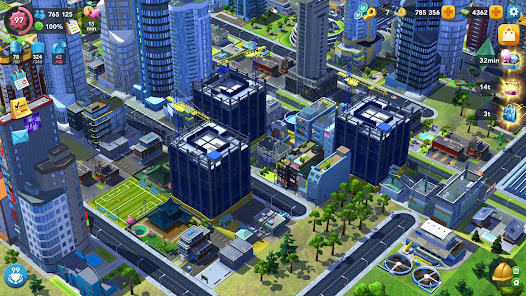
How does water coverage work?
Each water building covers a circle, and every building inside that circle draws from its output. Buildings outside the circle are dry regardless of spare capacity nearby, which makes placement a question of geometry rather than of budget.
The overlay shows coverage clearly, so there is no reason to guess. Check it before placing a tower, and check it again after expanding, because a district that grows outward can push new houses beyond the radius of the tower that served the original cluster.
Water buildings also need road access like any other structure. A tower in a field with no connection is a tower that does nothing, which is a surprisingly common early mistake. Connect first, then check the overlay, because an unconnected building shows no coverage at all and looks broken rather than misplaced.
On this page
What happens when a house has no water?
It loses satisfaction and stops producing the population it was generating. The house remains visible and looks occupied, but it contributes nothing to your tax income and it shows a complaint icon.
Because the visual is subtle, players often notice the income drop before they notice the cause. Checking the utility overlay when income falls is the fastest way to identify whether water, power, or sewage is responsible.
The fix is either more capacity or better coverage. Sometimes a second tower is needed; sometimes simply moving the existing one a few tiles closer to the houses solves it for free. Before buying anything, look at where the dry buildings are relative to your towers, because the answer is often placement rather than quantity.
| Source | Trade-off | Best used for |
|---|---|---|
| Water tower | Cheap, limited output | Small or scattered districts |
| Pumping station | Higher output, higher cost | Dense residential areas |
| Distributed towers | More placement, more upkeep | Spread-out cities |
| Single large station | Concentrated capacity | Compact high-density cores |
Should you use towers or pumping stations?
Towers for scattered districts and stations for dense ones. A tower is cheap and quick to place, which suits a city that is still spreading out and does not yet know where its centre will be.
A pumping station costs more but supplies a larger number of buildings, which is efficient once a district is built up and unlikely to move. The mistake is buying a station early, before the demand exists, and then having no coins for the houses it was meant to serve.
Mixing both is normal. Most mature cities end up with stations in the core and towers on the periphery, which matches capacity to density rather than applying one solution everywhere.
Does water interact with sewage?
Yes. Water supply and sewage treatment are separate systems, and a district can have plenty of clean water while its waste is unhandled. Both are needed before a residential area reaches its full potential.
The usual progression is water first, because it is cheaper and unlocks earlier, then sewage once the district is large enough to justify the building. Skipping sewage entirely caps how far those houses can develop.
Treat them as a pair when planning a new district. Building water now and sewage later means returning to the same area twice, which costs more than planning both from the start.
A useful rule is to build water and sewage at the same time as the road that opens a new district. All three are infrastructure, all three are needed before houses there can develop, and doing them together avoids the awkward phase where a district exists but cannot support the buildings you place in it.
It also helps to keep utility buildings on the edge of a district rather than in the middle of it. They occupy plots that could hold houses, and a tower on the periphery with a wide radius covers the same buildings while leaving the valuable central land for development.
How much reserve capacity should you keep?
Enough for the next round of upgrades. Water demand rises with every house improvement, so a system running at capacity is a system that will fail the moment you improve anything.
Reserve is not waste. It is what allows continuous growth, and it prevents the cycle of upgrade, outage, rebuild that consumes coins without increasing population.
Watch the indicator rather than estimating. It tells you exactly how close you are, and a glance before starting a batch of upgrades is cheaper than discovering the shortfall afterwards. The habit takes seconds and prevents the most common cause of a stalled residential district.
What are the common water mistakes?
Placing a tower without checking the overlay is the first, which leaves houses outside the radius while the player assumes they are covered. The second is upgrading houses without checking capacity.
The third is building one large station and relying on it for the whole city, which concentrates risk and becomes expensive to replace. The fourth is forgetting sewage until the district stalls.
The fifth is neglecting industrial water demand. Factories need water too, and a dry factory stops producing the materials your commercial buildings depend on. Because industrial zones are usually on the edge of the city, they are the easiest area to leave outside a coverage radius without noticing.
Frequently asked questions
Why do some houses have no water?
They are outside every tower’s radius, or demand has exceeded the capacity of the buildings covering them.
Do water buildings need roads?
Yes. They must connect to the road network like any other structure.
Is water separate from sewage?
Yes, they are separate systems and both are needed for a district to develop fully.
Can I move a water tower?
You can demolish and rebuild it. Check coverage before placing to avoid the cost.
Do factories need water?
Yes. Industrial buildings without water stop producing materials.
For utilities and services, see the SimCity BuildIt hub.
Official game information: www.ea.com.