This guide covers mini motorways tokyo map guide with practical steps for mobile players.
Quick answer: Tokyo packs clusters close together and cuts the map with water, so you need short local routes and a small number of deliberate crossings. Bridges are the tool that decides runs here. Build them early, keep them few, and never let two colours depend on the same crossing.
Tokyo is the opposite problem to a sprawling map. Everything is near everything else, which sounds easy and is not. Tight clusters mean junctions fill faster, and water means a single crossing can become the busiest tile on your map.
What makes the Tokyo map different?
The first difference is compression. Houses and destinations sit close together, so trips are short and cars arrive quickly. That makes early deliveries fast, and it makes queues build with very little warning.
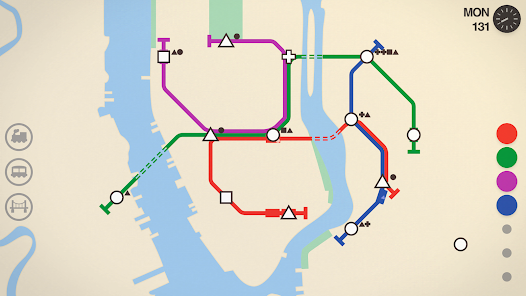
The second is water. Rivers and inlets break the map into sections, and traffic between sections has to cross at a limited number of places. Those crossing points become your real chokepoints, not the junctions in open ground.
The third is how quickly the map fills. Dense maps run out of usable space before they run out of houses. You will find yourself short of room long before you are short of tiles, which inverts the usual priority.
A fourth trait is that new clusters appear inside existing development rather than at the edges. Growth here thickens the map instead of extending it, so your layout gets tighter over time rather than longer.
On this page
How do you deal with the water?
Find the crossings before you build anything else. Look at where the land connects and plan your network around those points. A route that ignores the water has to detour later, and detours cost tiles twice.
Build bridges deliberately rather than reactively. A bridge placed in the first minute can be planned around. A bridge built under pressure usually lands in the wrong place and forces you to reroute everything near it.
| Water situation | What it does to traffic | Better approach |
|---|---|---|
| Single crossing serving two colours | Both queues fill at the same tile | Split the traffic before the bridge |
| Bridge placed at the widest point | Long crossing, slow trips | Cross at the narrowest available gap |
| One crossing for the whole map | Every trip funnels through it | Add a second crossing before it jams |
| Bridge built late | Routes detour around water | Plan crossings from the first minute |
How do you manage the density?
Keep local roads as short as you physically can. On a dense map, every extra tile in a local route adds traffic to a junction that already has too much. Direct lines matter more than neat shapes.
Separate colours aggressively. Two colours sharing a corridor on a compact map will collide quickly, because there is no slack in the system. Give each its own line even when a shared road would save tiles.
Leave one clear line of space through the busiest area. Dense maps fill from the middle, and once the middle is walled off you cannot add capacity where it is needed. That empty line is your future upgrade room.
Watch junctions rather than houses. In dense areas the queue often starts at a merge rather than at a house, and a merging jam is harder to spot because no ring fills immediately.
Which tools matter most here?
Bridges come first. Water is the map’s defining constraint, and bridges are the only tool that answers it. A run without adequate crossings ends early regardless of how well the rest is built.
Roundabouts come second. Tokyo has plenty of junctions where three or four roads meet in a small space, and those are exactly the places where letting cars pass through beats making them wait.
Traffic lights are more useful here than on open maps. Dense crossings genuinely do need arbitration, and a light at a busy four-way junction can keep two flows moving instead of deadlocking.
Motorways are least important. Distances are short, so the time saved is small and the entry and exit handling is awkward in tight space. Take one only when a specific long trip justifies it.
How should you place upgrades?
Take bridges whenever they are offered early. Crossings are the constraint, and an extra one changes what the whole network can do. It is the highest-value pick on this map.
Take road tiles when the map is filling rather than extending. Tokyo consumes space quickly, and a reserve lets you keep separating colours instead of forcing them together.
Take junction tools once you can see which crossing is failing. A roundabout placed on speculation still costs you the choice, and dense maps usually reveal their problem junctions within a few minutes.
Do not spend an upgrade on a motorway because it looks impressive. On a compact map it adds complexity to tight spaces and rarely solves the problem that is actually ending your run.
What mistakes end Tokyo runs?
Ignoring the water in the opening minute is the first. Every tile spent on a route that will need a crossing later is a tile you will spend again. Plan crossings first.
Sharing a bridge between colours is the second. That single tile becomes a two-way jam, and both colours stall at once. Separate before the crossing, not after.
Filling the centre completely is the third. Dense maps grow inward, so the middle is exactly where you will want spare room. Keep a lane open even when it looks wasteful.
Overbuilding local roads is the fourth. Long local routes in a tight map add traffic to junctions that cannot absorb it, and the resulting jam appears far from where you built.
Frequently asked questions
Is Tokyo the hardest map?
It is among the hardest for players who build long routes. Its density and water punish sprawl severely, while players who build tight and separate do well.
How many bridges do I need?
Enough that no single crossing carries two colours. Rather than a fixed number, watch for a crossing that fills and add another before it jams completely.
Should I use traffic lights here?
More often than on open maps. Dense four-way junctions benefit from arbitration, provided the light is placed where flows genuinely conflict.
Why do my runs end suddenly?
Because density means queues build fast. A junction that looked fine a moment ago can fill between two glances, so check the map more often than usual.
Are motorways worth taking?
Rarely. Tokyo’s trips are short, so the benefit is small and the space cost is high. Take one only for a specific long connection.
Official game information: dinopoloclub.com.