This guide covers good pizza great pizza how to solve all dressed orders with practical steps for mobile players.
Quick answer: an all dressed order means the customer wants every topping you currently have, so the task is completeness rather than decoding. Put one of each available ingredient on the pizza and check the list before baking. The common failure is missing one topping because you worked from memory instead of scanning the full ingredient bar.
These orders are simple in principle and surprisingly easy to get wrong in practice.
There is no riddle to solve and no clue to interpret. The whole difficulty is remembering to include everything.
That makes it a different kind of test from the other special orders, and it needs a different habit.
What follows is how to make sure you never miss one.
It is worth saying plainly that this order is not a test of skill. Any player can complete it reliably with the right routine, and the routine is not difficult to learn.
What it tests is whether you have a habit for completeness, and habits are built deliberately rather than acquired by accident.
What the order actually asks for
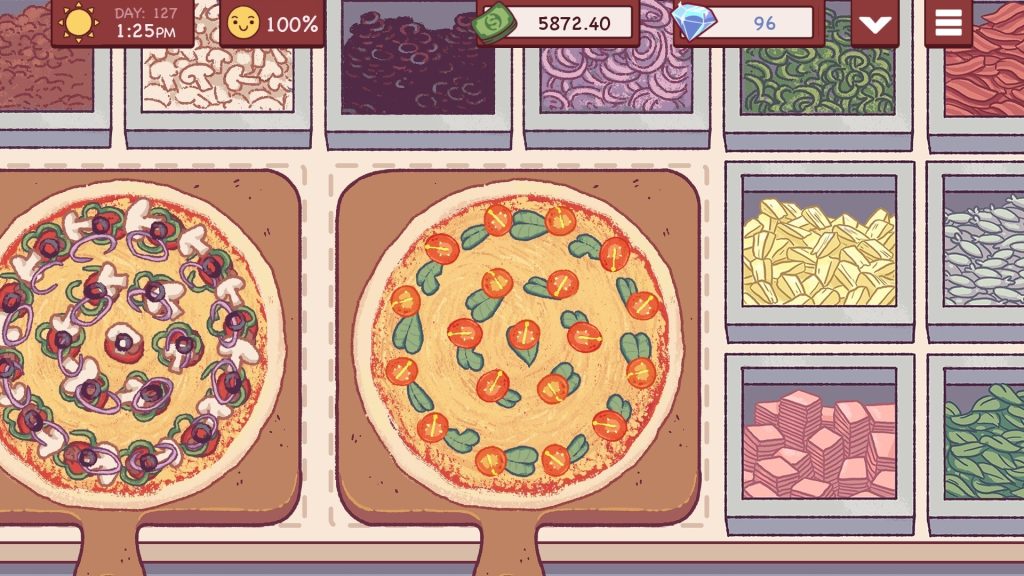
An all dressed pizza contains every topping available to you at that point in the game.
As you unlock more ingredients, the order grows to include them as well.
That means the pizza you make in an early chapter is much simpler than the one you make later.
The order scales with your pantry rather than staying fixed.
That is worth knowing, because players sometimes assume the order is a standard recipe they can memorise.
It is not. It is a description of everything on the shelf.
Read it that way and it becomes straightforward.
On this page
How to build one reliably
Start by scanning the ingredient bar from one end to the other rather than picking from memory.
Place one of each as you go, working in a consistent direction.
A consistent direction is the important part, because it stops you doubling back and losing track.
When you reach the end of the bar, you are finished.
Check the order against the pizza before baking rather than after.
That single step prevents almost every failure on this order type.
It costs a second and saves a remake.
If you keep missing the same ingredient, that is a sign it is positioned somewhere you do not naturally scan. Adjust the direction of your scan rather than trying to remember harder.
Memory is unreliable under pressure; a fixed route through the ingredient bar is not.
Why people miss toppings
The most common cause is relying on memory. You think you know what you have, and you skip something.
The second is working in a scattered order, which makes it impossible to tell what you have already placed.
The third is distraction. A busy queue pulls your attention away mid-build and you return without knowing where you were.
All three are solved by the same habit: a fixed scan order and a final check.
It is a small discipline rather than a skill.
Once it is automatic, these orders become your easiest income.
That is a useful thing to have when the shop is busy.
Handling the order when the shop is busy
All dressed orders take longer than simple ones because there are more ingredients to place.
That means they compete for time with the rest of the queue.
If several customers are waiting, decide whether this one can be started now or should wait until the rush eases.
Serving by urgency usually means delaying the all dressed order, because it is the slowest to complete.
That is fine as long as the customer is not close to leaving.
If they are close to leaving, start immediately and accept that others may suffer.
Judging that trade-off is the actual skill here.
Some players like to place the base first and then work through the toppings, which gives a clear visual reference for what is already there.
Others prefer to place toppings as they scan, which is faster but requires more discipline about order.
Either works. Pick one and use it consistently, because consistency is what makes it reliable.
How the order changes as you progress
Each new ingredient you unlock makes the all dressed order slightly harder to complete accurately.
That is a subtle difficulty curve most players do not notice until they start missing things.
When you unlock a new topping, expect the next all dressed order to catch you out.
The scan-and-check habit scales better than memory, which is why it is worth building early.
It also helps to look at the ingredient bar when you unlock something, so you know what has been added.
A few seconds of familiarisation prevents a missed topping later.
Small adjustments like that keep the order type easy as the shop grows.
Common mistakes with these orders
Building from memory. The most common cause of a missing ingredient.
Skipping the final check. The second most common.
Starting mid-rush. Guarantees a distracted build.
Assuming a fixed recipe. The order changes as you unlock ingredients.
Abandoning a nearly complete pizza. Finishing is usually faster than restarting.
None of these require new knowledge to fix.
They require a system rather than attention.
Over time these orders become routine, and a routine order is a good order: it earns reliably without demanding your full attention.
One more thing worth knowing: the order does not care about quantities, only presence. A single piece of each topping satisfies it, so there is no reason to be generous.
That makes it faster than it looks, once you stop worrying about distribution and simply work through the list.
Place, scan, check, bake. The whole order fits into that sentence.
The trick to All Dressed orders is to work from the sauce outward rather than topping by topping. Sauce and cheese set the base, and every topping you add afterwards has to sit on that base, so a thin start leaves you fighting the pizza for the rest of the build.
It also helps to count what is actually being asked for before you start. These orders usually name several toppings in one breath, and picking them out first stops you from adding something extra that voids the whole thing.
Frequently asked questions
Does all dressed mean every topping?
Yes, every topping currently available to you. The set grows as you unlock more.
What happens if I miss one?
The order fails and the customer leaves unhappy. You lose the payment and the tip.
Should I prioritise these orders?
Only when the customer is close to leaving. They take longer than simple orders.
Is there a way to see what I have placed?
The pizza itself shows it. Scanning the bar in one direction is more reliable than reading the pizza.
Do these orders appear often?
Regularly enough that building the habit is worth it early.
For more, see reading customer clues and unlocking new toppings. More coverage is on the Good Pizza, Great Pizza hub.
Official game information: www.goodpizzagreatpizza.com.