This guide covers mini motorways beijing map guide with practical steps for mobile players.
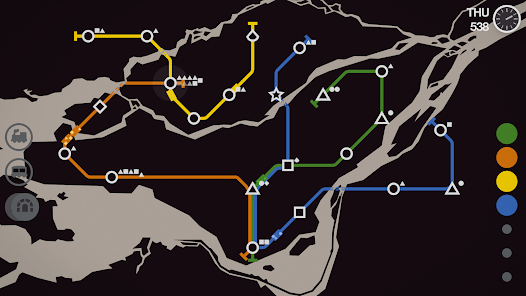
Quick answer: Beijing concentrates traffic in the middle, so the centre of the map decides the run. Keep central routes short and separated, push long-distance traffic to the outside, and treat the ring of districts as the place where new clusters will appear. A tidy centre with room to breathe beats a dense one.
Where Los Angeles spreads you thin, Beijing pulls you inward. Clusters cluster, and the middle of the map fills fastest. That makes the opening minutes more important here than on most maps, because a crowded centre is hard to unpick later.
What defines the Beijing map?
The defining pressure is central density. Destinations and houses both tend to gather toward the middle, so the same few tiles get requested by several colours at once. Space in the centre is the scarcest resource you have.
Around that dense core sit wider districts with more room. Traffic has to move between the core and those outer areas, which means your network needs both short local links and a few long connectors. Neither alone is enough.
The map also encourages circular movement. Houses on one side often need destinations on another, and the natural line between them curves around the dense middle rather than through it. Routes that cut straight across tend to jam.
Growth adds to the core before it adds to the edges. That is the opposite of a sprawling map, and it means your early centre layout sets a ceiling on your later score. Fix the middle early or live with it.
On this page
How should you handle the dense centre?
Keep central roads short and single-purpose. A centre road that serves two colours will eventually be asked to carry both at once. Splitting that traffic later costs more tiles than separating it now.
Do not route long trips through the middle. A car crossing the whole map through your densest area blocks everything behind it. Send those trips around the outside, even if the route is longer.
| Centre problem | What happens | Better approach |
|---|---|---|
| Two colours share one core road | Competing traffic jams at the middle | Separate the routes before they meet |
| Long trips routed through centre | One car blocks a dense junction | Push through-traffic to the outside |
| Centre fully built out | No room to add capacity | Leave one clear lane of space |
| Merges inside the core | Queue builds in the worst place | Merge outside, then enter once |
How do you connect the outer districts?
Build one or two connectors to the outside and keep them clean. A single wide corridor carrying district traffic is easier to manage than three thin ones. Fewer, better routes beat many tangled ones.
Watch the outer houses for queues rather than the centre. The centre is obvious because you are looking at it. An outer cluster filling quietly is what usually ends a Beijing run.
Extend outward rather than sideways when you can. Lateral roads in the outer ring compete with each other for tiles, while radial roads each serve a distinct group of houses.
Keep a reserve of tiles for a new district appearing. Beijing grows unevenly, and an unexpected cluster on one side can need a connector you have not budgeted for.
Which tools fit this layout?
Roundabouts earn their place in the centre. That is where several roads meet and cars must take turns. A roundabout lets them pass through without stopping, which is exactly what a dense middle needs.
Traffic lights work at the boundary between core and outer districts. That is where a busy connector meets a busy local road. Use them there and almost nowhere else.
Motorways are less dominant here than on wide maps. They help with long district-to-district trips, but they cannot fix a jammed centre. Treat them as support rather than as the answer.
Bridges and tunnels matter if the map’s terrain splits the districts. Check the layout early, because a connector that has to detour loses the benefit of being direct.
How should you spend upgrades?
Take road tiles when the centre is still growing. Density consumes tiles quickly, and running out mid-expansion strands houses you have already connected. Capacity is the safest pick on this map.
Take a roundabout as soon as a central junction starts queueing. That is the moment the tool pays for itself, and waiting usually means dealing with a jam instead of preventing one.
Delay motorways until your districts are actually far apart. On a compact map they are a luxury, and Beijing’s problem is congestion rather than distance.
Do not stack two junction tools on the same crossing. A roundabout and a light in the same place mostly cancel each other out, and you lose a choice you could have spent elsewhere.
What mistakes cost you this map?
Filling the centre completely is the first. It feels efficient because the space is there. It leaves you with no room to separate traffic when the second colour arrives in the middle.
Routing everything through a single core junction is the second. One blocked point in the densest area stops cars from every direction, and the queue fills before you notice.
Ignoring the outer districts is the third. Their queues build slowly and then complete suddenly. A glance at the edges every few seconds catches most of them.
Overusing traffic lights is the fourth. Each light adds a stop, and on a dense map those stops compound into the very congestion you were trying to prevent.
Frequently asked questions
Is Beijing harder than the wide maps?
It is harder in a different way. Wide maps punish poor long routes, while Beijing punishes a crowded centre. Players who like spreadsheets of space often find it harder.
Should I avoid building in the middle entirely?
No. Some central building is unavoidable because that is where the houses are. Keep it short and separated rather than avoiding it.
What is the best first upgrade here?
Extra road tiles in most runs. Capacity buys you the room to fix the centre later, and Beijing consumes tiles fast.
How do I stop through-traffic jamming the core?
Give it an outside route even when the direct line is shorter. A slightly longer path that avoids the dense middle keeps both flows moving.
Why do my runs end in the centre?
Because the centre is where several colours compete for the fewest tiles. Separating those routes early is the single biggest improvement available.
Official game information: dinopoloclub.com.