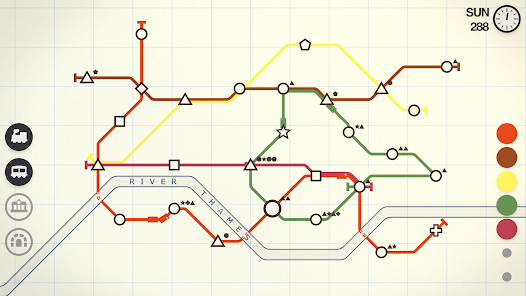
This guide covers mini motorways how to choose weekly upgrades with practical steps for mobile players.
Quick answer: Weekly upgrades in Mini Motorways let you choose between road tiles, bridges, tunnels, roundabouts, traffic lights and motorways. Pick the one that solves your current bottleneck rather than the one that looks strongest, and read the map before choosing. A bridge on an open map is wasted; road tiles on a river map are a delay rather than a fix.
The weekly choice is the only moment the game asks you to plan ahead rather than react. Most runs are lost by taking an upgrade that did not address the actual problem, and the mistake is invisible until the following week.
What upgrades can you choose from?
Road tiles, which extend your network. Bridges and tunnels, which cross water and terrain. Roundabouts and traffic lights, which control junctions. And motorways, which bypass congested routes.
Each solves a different problem, and they compete for a single choice. That is what makes the decision interesting rather than automatic.
The options available may vary by map and by week, so the choice is not always between all of them.
Knowing what each one does is the prerequisite. Choosing without that knowledge is guesswork.
On this page
How do you decide what to take?
Identify your current bottleneck first. Is a district unreachable, a road congested, a junction queuing, or a trip simply too long?
Match the upgrade to the answer. Unreachable across water means a crossing. Congested road means tiles or a motorway. Queuing junction means a control.
If you cannot name the bottleneck, take road tiles. They are rarely wrong, because the network always needs more.
Do not take an upgrade for a problem you expect rather than one you have. Speculation usually wastes the week.
And do not default to the same choice every week. The bottleneck moves as the city grows.
When should you take road tiles?
When your network is short of connections and the map has no crossing problem. Tiles are the safe default on open maps.
When a new district has appeared and needs connecting. Extending an existing road is usually cheaper than a new one.
When you have already solved the crossings and the junctions, and the only remaining issue is coverage.
Not when a river is splitting your city. Tiles will not cross water, and the district across it stays unreachable.
Not when your budget is already comfortable. Spare tiles do nothing; the upgrade is better spent elsewhere.
When should you take a bridge or tunnel?
When a district is unreachable across water or terrain. Nothing else solves that problem.
When an existing crossing is saturated and a second one would relieve it.
When the map’s geography forces it, which is true of most river and coastal maps.
Not on an open map with no water. A bridge with nothing to cross is a wasted week.
Check the placement carefully. A poorly placed crossing serves few destinations and the week is lost.
When should you take junction controls or a motorway?
Take a control when a specific junction queues and the surrounding roads are adequate. A roundabout or light can fix that cheaply.
Take a motorway when a long trip is failing despite clear roads, or when one congested section blocks a route that matters.
Not before the layout is sound. Controls and motorways cannot rescue a tangled network.
Not if the queue is caused by capacity rather than flow. A control changes priority, not capacity.
Treat both as late-game tools. Early on, tiles and crossings do more.
What are the common upgrade mistakes?
Taking the same upgrade every week is the first. The bottleneck moves and the choice should move with it.
Taking a control for a capacity problem is the second, which delays the failure without preventing it.
Taking tiles on a map that needed a crossing is the third, and it is the mistake that ends river runs.
Taking a motorway before the layout is sound is the fourth. It moves the congestion rather than removing it.
Choosing without naming the bottleneck is the last, and it underlies all the others.
One practical approach is to write down, each week, the single thing that most slowed the network. That note becomes the basis for the next choice, and after a few weeks you have a record of how the bottleneck moved through the city.
It also helps to check whether the upgrade you took last week actually helped. If the same problem is still there, the diagnosis was wrong and a different upgrade is needed.
Finally, resist the temptation to take a powerful upgrade for its own sake. Motorways and controls feel significant, but on most maps the humble road tile solves more problems than either.
Frequently asked questions
What is the best upgrade?
There is no universal best. The right choice is the one that solves your current bottleneck.
Should I always take road tiles?
No. They are a safe default on open maps, but useless when a crossing is what the map needs.
When are motorways worth it?
When a specific long route is failing despite otherwise clear roads.
Do controls help every junction?
No. Only the ones that queue, and only where the traffic pattern suits the control.
What if I choose wrong?
You lose a week rather than the run. The next choice can still correct course.
For the control side, read how to use roundabouts, or return to the Mini Motorways hub.
Official game information: dinopoloclub.com.