This guide covers mini motorways manila map guide with practical steps for mobile players.
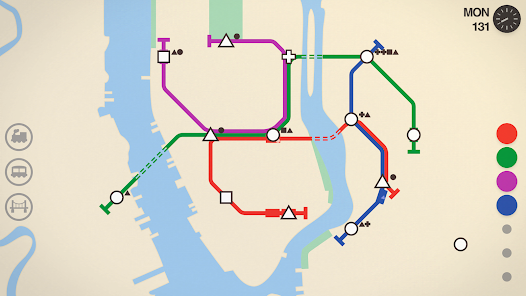
Quick answer: The Manila map in Mini Motorways is built around a bay and a river system, so water isolates districts and forces traffic through a few crossings. Keep your main routes parallel to the water rather than following every inlet, and bridge where dense housing faces dense destinations. The map rewards a compact layout and punishes long shoreline roads.
Manila’s geography creates a specific problem: it looks open, with plenty of coastline, but the water repeatedly interrupts routes. A road that follows the shore for a long distance serves very few destinations per unit of length, and length is what makes a network slow.
What does Manila’s geography do to a run?
It fragments the city. The bay and the river system cut districts apart, and the places where land connects become the only routes between them.
Those connection points carry everything. A district that reaches the rest of the city through one road will queue on that road as soon as it grows.
The coastline also tempts players into long, scenic routes. A road that traces the bay looks sensible and behaves badly, because it is long and serves little.
The result is a map that punishes wandering and rewards directness, which is the opposite of what the scenery suggests.
On this page
How should you lay out the main network?
Build short and direct between clusters. The distance between housing and destinations is what matters, not the distance along the coast.
Keep one spine road per landmass and branch off it. That gives each area a clear route to its crossings without every house needing its own road to the water.
Avoid following the shoreline unless the destinations are actually there. Coastline is not demand.
Leave room for a parallel route on the busiest landmass. Manila’s districts grow quickly, and a single road becomes a trap.
Check the crossings as the city grows. The point where land connects is where the map fails first.
Where should you bridge?
Where two dense areas face each other. A crossing between a housing cluster and a destination cluster is worth far more than one between two empty shores.
Keep the approaches short and free of junctions. A bridge that lands in a crossroads wastes the crossing.
Choose crossings that join existing roads. The bridge should connect networks, not create a new one that needs more roads to be useful.
Plan for two crossings rather than one in the busiest area. A single bridge concentrates all cross-water traffic into a queue.
Ignore the long coastline unless districts genuinely sit along it. Edge bridges consume upgrades and serve almost nobody.
How do you handle the flood-prone or irregular edges?
Treat irregular terrain as a constraint rather than a feature. Build around it rather than trying to bridge every inlet.
Where the water creates a narrow neck, a crossing there can serve two areas at once, which makes it efficient.
Where the water creates a wide gap, route around it rather than spending a crossing on a long span.
Keep an eye on which landmasses are effectively islands. An island needs at least one reliable crossing or it becomes unservable.
That check, made early, prevents the situation where a district fills with housing and cannot reach anything.
What are the common Manila mistakes?
Building along the coast is the first. It looks tidy and it produces long routes that serve few destinations.
Bridging scenic points rather than busy ones is the second.
Relying on a single crossing per landmass is the third, which guarantees a queue as soon as the district grows.
Ignoring the islands is the fourth. A landmass with no crossing becomes a stranded district.
Overspending on roads instead of crossings is the last. On Manila, the water decides the run.
How do you extend a Manila run?
Add crossings where the queues are, and keep the approaches clear. The bottleneck is almost always the connection point.
Use motorways to bypass a congested landmass if the upgrade is available, connecting distant clusters directly.
Prune redundant shoreline roads. A shorter network moves traffic faster than a longer one serving the same houses.
Rebalance the districts so that each landmass has both housing and destinations where possible.
Accept the ceiling. Manila’s geography limits how long any layout lasts, and the run is about delaying the failure.
One further habit helps on this map: count how many houses a proposed road actually serves before building it. A route that passes twenty homes is worth far more than one that passes five, and the difference compounds as the city grows.
It also pays to check the crossings before adding new districts. If the bridge is already queuing, adding more housing on the far side simply lengthens the queue rather than growing the city.
Finally, keep the network shallow. A few levels of branching from a spine moves traffic better than a deep tree where every trip passes through the same junctions.
The thing that catches most players on this map is how quickly the centre fills once it starts. Manila rewards committing to a layout early rather than adding roads reactively, because every late addition competes for the same few tiles the centre has left.
It also helps to decide which crossings are permanent before you build them. Once a bridge carries a colour group, rerouting that group means demolishing and rebuilding, which costs tiles you will want later.
Frequently asked questions
Is Manila a hard map?
It is moderately hard. The water fragments the city, and the coastline tempts players into inefficient routes.
Should I build along the shore?
Only where destinations are. Coastline without demand is wasted road length.
How many bridges does Manila need?
Enough to give every landmass a route out, with two in the busiest area.
What about the islands?
Each needs at least one reliable crossing. An island with no bridge becomes a stranded district.
What ends a Manila run?
A destination that cannot be reached in time because the only route to it is congested or missing.
For the basics, read how to use traffic lights, or return to the Mini Motorways hub.
Official game information: dinopoloclub.com.