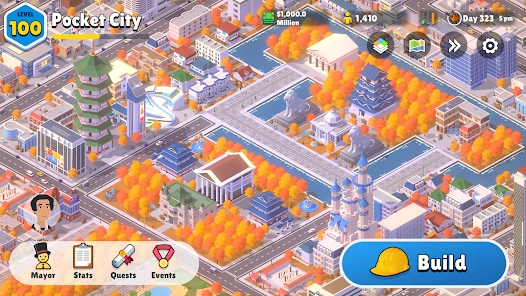
This guide covers pocket city 2 how to manage recreation facilities with practical steps for mobile players.
Quick answer: To manage recreation facilities in Pocket City 2, treat them as happiness buildings with coverage radii rather than as decoration. Place them where residents are, spread several small ones rather than building one large attraction, and check whether the district actually needs recreation before adding it. A facility in an empty area costs upkeep and serves nobody.
Recreation sits between the services and the parks: more expensive than green space, less expensive than a hospital, and useful for the same reason, which is that residents want somewhere to go. Getting the balance right is mostly a question of placement.
What counts as recreation?
Facilities that residents use for leisure rather than for a specific need. They raise happiness in their area, and some of them are large enough to become landmarks.
They differ from parks in scale and cost. A park is a small plot that improves its immediate surroundings; a recreation facility is a bigger investment and usually affects a wider area.
They differ from services in purpose. Nothing is dispatched from a recreation facility, and it does not prevent fires or crime; it makes the area more pleasant to live in.
That places them firmly in the happiness layer of the game, alongside parks and against pollution.
On this page
Where should recreation facilities go?
Among the residents they serve. Coverage is a radius, so a facility placed on the edge of the city benefits the fewest people for the same upkeep.
Where they can also anchor a district. A larger facility draws people to an area, which can make the surrounding blocks more attractive and help them fill.
Not on prime commercial frontage. Like any large building, a recreation facility occupies land that could generate tax, so put it a street back where it still covers residents.
And spread rather than concentrate. Two smaller facilities in two districts usually produce more total happiness than one large one in a single district.
How much recreation do you need?
Enough to cover the districts where people live, and no more. The complaint list is the guide: if residents are unhappy about having nothing to do, add recreation; if they are unhappy about services, recreation will not help.
Build one, then watch the happiness indicator over a few cycles. If it moves, the district needed it; if not, you have bought upkeep without a benefit and can leave the next one until later.
Scale matters less than coverage. A modest facility that reaches the whole district is more useful than an impressive one that reaches half of it.
Resist the urge to build every type. The game rewards coverage rather than variety, and a district with one well-placed facility is happier than one with three scattered across the map.
How does recreation interact with parks?
They do the same job at different scales. Parks are cheap, small and best used in quantity; recreation facilities are larger and better used as anchors for a district.
The cheapest strategy is parks first and recreation second. Parks fill gaps and lift the baseline, and recreation is added when a district needs more than green space.
They also work well together. A park beside a recreation facility makes the whole area more attractive than either would alone, for less than the cost of a second facility.
If the budget is tight, which it usually is early, parks are the better buy. Recreation is what you add when the city can afford to be generous.
How does recreation affect growth and money?
It raises happiness, which keeps residents and attracts more of them, which grows the tax base. The effect is indirect but it compounds.
It also costs upkeep forever, which is why placement matters. A facility covering empty land is a permanent cost with no return, and it is easy to create one by building ahead of the district.
The right sequence is district first, residents second, recreation third. Building in that order means the facility has somebody to serve from the day it opens.
Treat recreation as an investment in retention rather than in growth. It is what stops a working district from emptying when something else goes slightly wrong.
What are the common recreation mistakes?
Building one large facility instead of several smaller ones is the first. Coverage is what matters, and one building covers one area.
Placing it on the edge of the city is the second. The people who benefit are the ones nearby, and the edge has the fewest of them.
Building before residents arrive is the third, and it is the same mistake as buying land early: upkeep now, benefit later.
Using recreation to fix a service problem is the fourth. It will not put out a fire or reduce crime, and the actual complaint remains.
Ignoring parks in favour of facilities is the last. The cheapest happiness building in the game is still a park.
One way to decide whether a district needs recreation rather than more parks is to look at how full it is. A district that has filled completely and is still unhappy has probably outgrown green space, while a district that is half empty usually has an access or utility problem that no facility will fix.
It also helps to place recreation where residents pass it rather than where it fits neatly. A facility on the route to the shops is used more than the same building on a back street, even though the radius is identical.
Finally, remember that a facility you can see from the street is doing two jobs. It covers the radius, and it makes the district feel like somewhere with a centre.
Frequently asked questions
Do recreation facilities count as services?
They affect happiness like services do, but nothing is dispatched from them and they do not prevent incidents.
Is one large facility better than several small ones?
Usually not. Coverage is a radius, so distribution beats size.
When should I build recreation?
After the residents arrive, not before. Building ahead of the district is upkeep without benefit.
Do parks and recreation stack?
They both raise happiness in their area, so placing them together makes an area more attractive than either alone.
Can recreation fix an unhappy district?
Only if happiness is the problem. Missing services, pollution and traffic will still drag it down.
For the cheaper option, read how to use parks, or return to the Pocket City 2 hub.
Official game information: pocketcitygame.com.