This guide covers simcity buildit how to provide fire coverage with practical steps for mobile players.
Quick answer: Fire coverage in SimCity BuildIt comes from fire stations that protect buildings within a radius. Buildings inside the radius are protected; buildings outside it risk damage and generate complaints. Place stations so their circles reach your residential and industrial zones, and check coverage before expanding, because new buildings on the edge of a district are the ones most likely to fall outside protection.
How does fire coverage work?
Each fire station covers a circle on the map. Buildings inside that circle are protected from fires and their satisfaction is supported by the service. Buildings outside are exposed, and the risk grows with how far they sit from any station.
The overlay shows coverage clearly, so placement can be checked rather than guessed. A station placed for convenience rather than coverage protects the buildings next to it and leaves the rest of the district exposed.
Fire stations also need road access. An isolated station with no connection provides no service at all, which is the same mistake players make with power and water. Connect the road first, then check the overlay, because an unconnected station shows no coverage and looks like a placement problem rather than a missing road.
On this page
What happens when a fire breaks out?
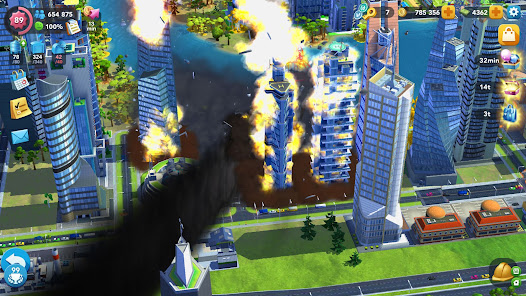
An uncovered building can catch fire, and the fire spreads to nearby buildings if nothing responds. The result is damage that costs coins to repair and a district that stops producing while it recovers.
Covered buildings are protected, so the practical consequence of missing coverage is concentrated loss in one area rather than a city-wide problem. That makes fires a local risk that rewards a local fix.
The repair cost is usually smaller than the income lost while the buildings sit damaged, which is why prevention is the better investment even when the fire itself seems minor. A district that stops producing for an hour costs more than the station would have, and the loss is invisible because nothing appears on the finance screen.
| Service | Effect of missing coverage | Priority |
|---|---|---|
| Fire station | Fire risk and repair costs | High once the city grows |
| Police station | Crime complaints and satisfaction loss | Medium |
| Health clinic | Reduced satisfaction and slower growth | Medium |
| Parks and leisure | Lower happiness, no penalty to safety | Low |
Where should you place fire stations?
At the junction of the areas you most want to protect, rather than in the middle of any one district. A station on a boundary can cover the edge of two neighbourhoods, which is more efficient than one station per area.
Keep industrial zones covered as well. Factories are valuable, they stop producing when damaged, and they are often placed on the outskirts where coverage is weakest.
As the city grows, add stations at the new edges rather than replacing old ones. Coverage is cumulative, so a network of smaller stations generally protects a spread-out city better than one large one in the centre.
When should you start buying fire coverage?
Once the city has enough buildings that a fire would cost more than the station. In the very early game the risk is small and coins are better spent on power and water; by the mid-game, one fire in an uncovered district costs more than the station would have.
A reasonable trigger is the first expansion beyond your original cluster. New districts on the edge are exactly the places least likely to be covered, and they are also the places where you have just spent expansion items.
Do not wait for a fire to teach you the lesson. The station is a predictable cost, while the fire is an unpredictable one that arrives at the worst moment.
When you do build, put the station where the roads already are. Utilities that require a new road spur cost more than they appear to, because the road itself takes a plot and the coins you were saving for the station. Placing it on an existing junction avoids both expenses.
Finally, review coverage whenever you expand. New districts are added at the edge of the map, which is exactly where existing stations do not reach, and the buildings you have just paid expansion items for are the ones most exposed to a fire you did not plan for.
How does fire coverage interact with other services?
All the services contribute to satisfaction in the same way, and a district missing several of them develops slowly even if none of them causes a disaster. Fire coverage is the one with a concrete loss attached, which is why it tends to come first.
Police and health coverage improve satisfaction and therefore growth, without the repair bill. Once fire is handled, adding those services to a district is the natural next step.
Stacking services in one area and leaving another bare is the common error. A little coverage everywhere beats a perfect district next to an unprotected one, because satisfaction is calculated locally and the neglected district drags down the city average while contributing nothing.
What are the common fire coverage mistakes?
Building stations for appearance rather than coverage is the first. The second is ignoring industrial areas, where a fire stops production as well as damaging buildings.
The third is waiting until a fire happens. The fourth is concentrating all coverage in the city centre while the edges, which are the fastest-growing areas, sit exposed.
The fifth is forgetting road access. A station that is not connected to the network provides nothing, and the overlay will show it clearly if you look. Check coverage immediately after building rather than assuming the placement worked, because the difference between a working station and a decorative one is a single road tile.
A station that sits behind a one-way road will still send trucks, but they arrive late, and a fire that is already spreading gains a minute on you while they queue. When you place a station, watch the route the trucks actually take rather than the straight-line distance on the map, because the radius circle does not account for traffic.
It also pays to keep one station near the industrial zone rather than concentrating all of them downtown. Industrial fires spread into residential blocks quickly, and the few seconds saved by a closer station are usually the difference between one lost building and a whole row.
Frequently asked questions
Do buildings catch fire without a station nearby?
Yes. Uncovered buildings are exposed to fire risk, and a fire can spread to neighbours.
Does fire coverage affect income?
Indirectly, through repair costs and lost production while buildings are damaged.
Do I need to cover industry too?
Yes. Factories stop producing when damaged, which stalls the materials everything else needs.
Can one station cover the whole city?
Only a small one. Larger cities need several stations placed at the edges of growth.
Is fire coverage more important than parks?
Yes. Parks improve happiness, while fire coverage prevents a concrete loss.
For services and layout, see the SimCity BuildIt hub.
Official game information: www.ea.com.