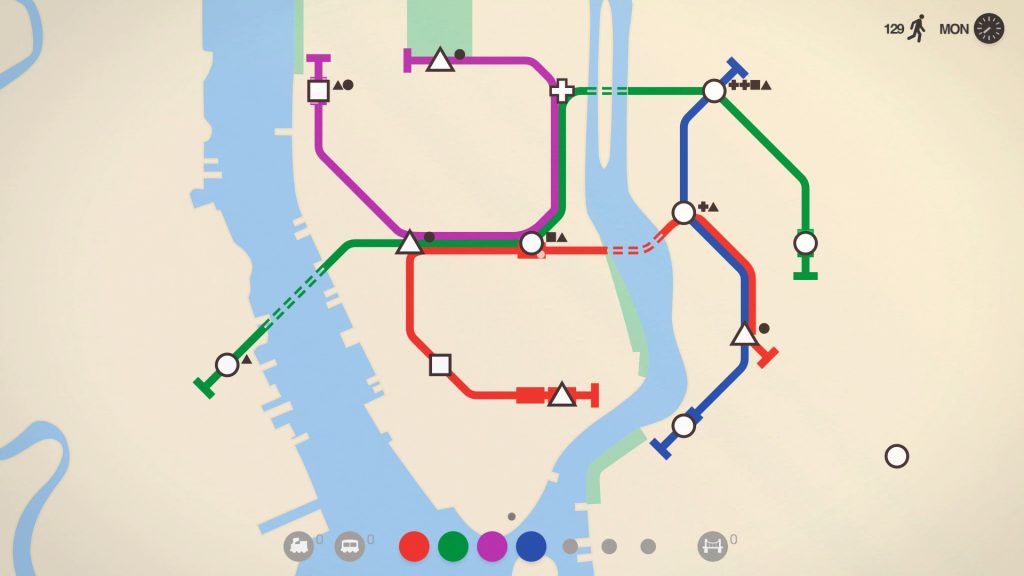
This guide covers mini metro gameplay overview with practical steps for mobile players.
Quick answer: Mini Metro is a minimalist puzzle game about drawing subway lines between stations and keeping them from overcrowding. Passengers are shapes, trains carry them between matching shapes, and a station that stays full for too long ends the run. There is no combat and no timer on your decisions unless you choose extreme mode, so the challenge is entirely in reading a growing network.
A useful habit is to scan the whole map between actions rather than watching the line you just drew.
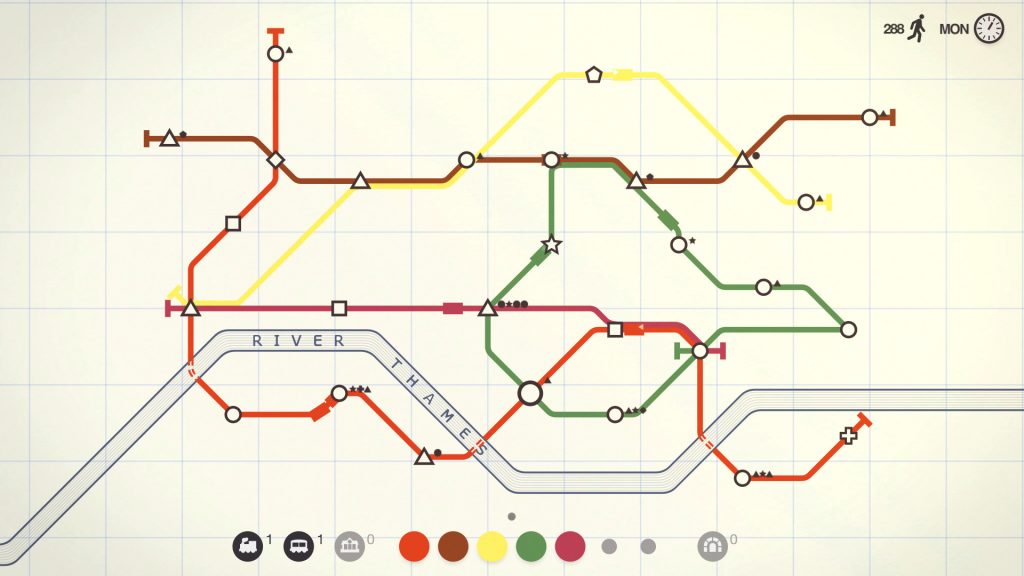
What is the core loop?
Stations appear, passengers accumulate, and you draw lines to connect them. Trains run automatically along the lines, picking up passengers whose destination shape is on their route.
When a station gets too full, a countdown begins. If it runs out, the run ends.
Your tools are limited: a few lines, a few trains, and occasional upgrades. The whole game is deciding where to spend them.
The loop repeats as the map grows, with more stations demanding more coverage from the same resources.
That growing gap between demand and capacity is the game.
Interchanges are the only mechanism that lets a passenger change direction, which is why they matter more than they appear.
A network without them forces every passenger onto a single route, and single routes are what overflow first.
On this page
How do passengers actually behave?
Each passenger is a shape, and they want to reach a station of the same shape. A circle wants a circle; a triangle wants a triangle.
They board a train if their destination is somewhere along its route, and they transfer at interchanges.
That makes network design the real subject. A passenger who has to transfer twice is a passenger who occupies a platform for longer, and platforms are what you are trying to keep clear.
Rare shapes complicate this, because few stations serve them and the journeys are long.
Understanding passenger routing is what turns the game from drawing to planning.
| Element | What it does | Pressure it creates |
|---|---|---|
| Stations | Generate and receive passengers | Fill up over time |
| Lines | Define routes | Limited in number |
| Trains | Carry passengers | Limited frequency |
| Interchanges | Allow transfers | Concentrate traffic |
| Tunnels | Cross water | Scarce on river maps |
It also means there is no wrong order to play the maps. You can start anywhere and learn the same lessons.
The cities differ in difficulty, but the skills transfer directly between them.
How does progression work?
There is no persistent progression. Each run starts fresh, and the only thing that carries over is your understanding of the maps.
Upgrades arrive during a run, offering choices between resources. Those choices shape what your network can do.
Maps are based on real cities with distinctive geography, and each one emphasises a different problem.
That makes map knowledge the real long-term asset, because recognising a city’s shape tells you how to build on it.
The game is a series of short runs rather than a campaign.
The difficulty curve is gentle at first and then steepens sharply once the map has more stations than your lines can comfortably serve.
That transition is where most runs end, and it is the same on every map.
It also helps that failures are short. A run that ends in two minutes still taught you something about that city.
Is it difficult?
It is easy to understand and hard to master. The rules take a minute; reading a crowded network takes many runs.
Failure is gradual and legible, which makes it a good game to learn from. You can usually see which station killed you and why.
That legibility is unusual in the genre and is a large part of why the game is so replayable.
Extreme mode removes the pause and tightens the rules, which raises the difficulty considerably for experienced players.
Beginners should stay in normal mode until they can read a network quickly.
It also avoids the usual mobile trappings entirely. There are no ads interrupting play and no energy system gating sessions.
That restraint makes it easy to recommend to almost anyone.
What makes it distinctive?
The restraint. There is almost no interface, no score chasing beyond the run, and no narrative. What remains is the pure problem of moving shapes efficiently.
That minimalism is not a limitation but the design. Every element that would distract from the network has been removed.
The result is a game that feels calm even when it is going badly, which is rare.
It also makes it easy to pick up for five minutes, which suits its mobile origins.
It is a puzzle game that respects your time almost completely.
It also suits players who like the process more than the result. The score is almost incidental to how the network felt while it worked.
That mindset is what keeps people playing after dozens of failures.
If you are unsure, play one run. The game explains itself faster than any description can.
Who is it for?
Players who like planning and optimisation rather than action. The appeal is in recognising a pattern and responding before it becomes a problem.
It suits short sessions and repeated attempts, since runs are quick and restarts are instant.
It does not suit players who want progression systems, unlocks, or a reason to keep playing beyond the score.
There is nothing to collect and nothing to complete, only maps to understand better.
If that sounds appealing, it will hold your attention for a long time.
Most players describe it as a game they return to rather than one they finish, which is the right way to think about it.
Frequently asked questions
Is there an ending?
No. Runs end when a station fails, and you start again.
Does it have progression?
No persistent unlocks. Your skill is the only thing that improves.
Can I pause?
Yes, in normal mode. Extreme mode removes it.
Are the maps real cities?
Yes, each based on a real city with its distinctive geography.
Is it hard?
Easy to learn, difficult to master. Failure is usually clear enough to learn from.
For systems in detail, see the Mini Metro hub.
Official game information: dinopoloclub.com.