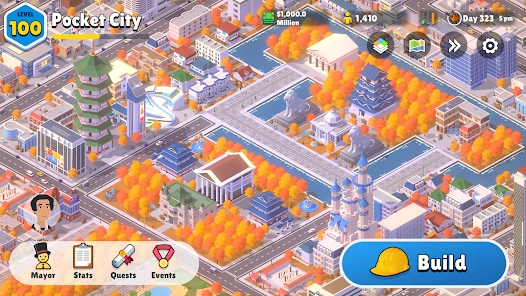
This guide covers pocket city 2 how to manage city finances with practical steps for mobile players.
Quick answer: To manage finances in Pocket City 2, keep spending behind development. Build only what has a tax base to support it, complete quests for early income, and raise taxes only when you can watch the effect on happiness. A city that grows one district at a time pays for itself, while a city that buys land and lays roads ahead of demand runs a permanent deficit.
Money in Pocket City 2 is less about optimisation than about pacing. The economy punishes anticipation and rewards completion, which is the opposite of how most city builders train you to think.
Where does income come from?
Taxes on developed buildings, plus quest rewards and any tourism or event income your city generates. The tax base is the foundation, and it grows only when buildings actually appear rather than when land is zoned.
That distinction explains most early deficits. Players zone a large area, see the income projection rise, and then wonder why the balance is negative while the land sits empty waiting for roads and utilities.
Quest rewards are the other reliable stream, and they are the cheapest to earn because they pay for actions you were taking anyway. Completing them as they appear funds expansion without any risk to happiness.
Tourism and special events come later. They are welcome when they arrive, but building a city around them before the fundamentals work is a way to spend money on attractions that nobody visits.
On this page
Where does the money go?
Upkeep on everything you have placed, including roads, utilities, services and land. Upkeep is charged whether or not a building is being used, which is why unused infrastructure is the most expensive thing in the game.
New construction is the visible cost, and it is usually the smaller one over time. A power plant costs once to build and then charges you every cycle for the rest of the save.
Land purchases are the quiet expense. Buying a plot commits you to upkeep and to connecting it, and a plot that stays empty is pure loss until it develops.
Service buildings are the other recurring cost, and they scale with coverage rather than with population. Two overlapping police stations cost double and protect the same streets.
How should you spend in the first few hours?
Spend on whatever makes the current district develop. That means roads, then power, then water, then the zone itself, in that order, and nothing else until buildings appear and start paying tax.
Add one service at a time and watch the happiness indicator. If it moves, the service was needed; if it does not, you have bought upkeep without a benefit and can leave the next one until later.
Avoid buying land until the district you have is full. Land is cheap and it is not the constraint; coverage and access are, and both are cheaper to extend within the area you already own.
Keep a reserve for a disaster or an unexpected service need. A city with no buffer is one incident away from a deficit, and the recovery usually costs more than the reserve would have.
When should you raise taxes?
When the city is happy and developing, and only in small steps. Higher taxes raise income per building but reduce happiness, and unhappy citizens leave, which removes the base you were taxing.
Test one change at a time. Raise the rate, watch the happiness indicator and the population trend over a few cycles, and reverse it if either falls.
Do not raise taxes to fund expansion. That is borrowing against the thing you are trying to grow, and it usually produces a city that is larger and poorer than it was before.
Lowering taxes is a legitimate tool as well. If the city is stagnant and you can afford the drop, a lower rate can restart growth, and the larger tax base often pays back the difference.
How do you fix a deficit?
Find the unused infrastructure first. Roads serving nothing, services with no residents in range and land that never developed are all costs with no matching income, and removing them is faster than raising revenue.
Then check for overlaps. Two service buildings covering the same streets can usually become one, and the saving is immediate and permanent.
Then look at the zone mix. If commercial is over-zoned relative to residential, the shops do not develop, which means they do not pay tax while the roads serving them still cost money.
Raising taxes is the last resort rather than the first, because it reduces the population that generates your income.
What does a healthy budget look like?
A modest surplus that grows with the city rather than a large one built by starving services. The surplus exists to fund the next district, not to sit in a treasury.
Income should be roughly matched by upkeep plus a margin, and the margin should grow as the city does. A city whose surplus shrinks as it grows is developing in a way that does not pay for itself.
Debt is not really a mechanic here, which makes the whole system gentler than it first appears. You cannot go bankrupt in a way that ends the run, so a deficit is a signal to fix rather than a fail state.
The practical habit is to look at the balance before every purchase. If the purchase does not make something develop, it can wait.
Track the balance as a trend rather than a number. A city with a small surplus that grows each cycle is healthier than one with a large surplus that is quietly shrinking as upkeep catches up with it.
Frequently asked questions
Why is my income so low?
Usually because large areas are zoned but not developed. Buildings pay tax; empty land does not.
Should I raise taxes to grow faster?
No. Raising the rate reduces happiness, and unhappy citizens leave, which shrinks the tax base you were trying to grow.
What is the biggest waste of money?
Overlapping service coverage and land bought before it can be connected and developed.
Do quests matter for income?
Yes. They are a reliable early source of funds for actions you were going to take anyway.
Can I go bankrupt?
The city can run a deficit, but there is no defeat state. A deficit is a prompt to cut costs rather than an ending.
For the cost side, read how to organize a city budget, or return to the Pocket City 2 hub.
Official game information: pocketcitygame.com.