This guide covers pocket city 2 gameplay overview with practical steps for mobile players.
Quick answer: Pocket City 2 is a city builder for phones and tablets where you zone land, place utilities and services, and watch a small town turn into a city. It is a single purchase, it plays offline, and it adds a walkable free roam mode on top of the usual overhead view. There are no energy timers and no adverts, so you play in sessions that end when you decide.
The game occupies a specific niche: a builder designed for a device you carry, rather than a desktop simulation squeezed onto a small screen. Everything about its pacing follows from that, including the short sessions, the forgiving failure states and the lack of a long tutorial.
What do you actually do in it?
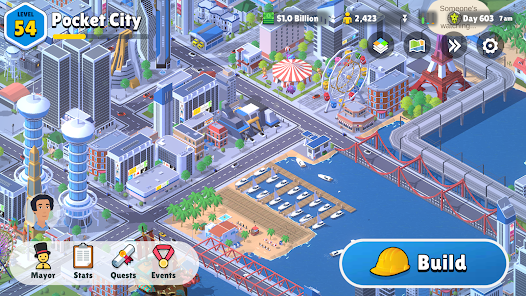
You draw roads, paint zones and place buildings. Residential, commercial and industrial zones develop over time as demand rises, and the buildings that appear are what generate tax, jobs and traffic.
Around that loop sit utilities, services, pollution, happiness and a budget. None is deep enough to need a spreadsheet, and all of them interact enough that ignoring one eventually shows up as a district that will not fill.
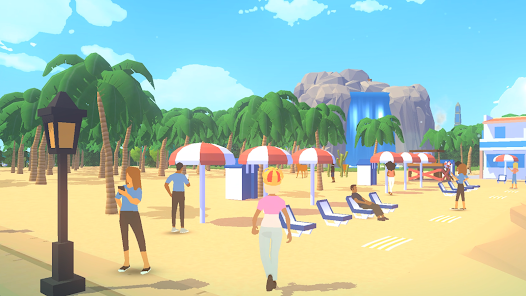
On top of the building sits free roam, where you control an avatar and walk the streets you made. It is optional and it is the fastest way to see problems that the overhead view hides.
Quests run alongside all of it, introducing each system in turn and paying you for using it.
On this page
How does it differ from other mobile city builders?
The monetisation model is the biggest difference. There is no energy meter, no premium currency and no advert break interrupting a build. You buy the game and you play it.
That changes the design in ways you can feel. Without a timer to sell, the game has no reason to slow your progress artificially, so a session is limited by your attention rather than by a resource.
It also means the game works offline, which matters for a title designed around short sessions on a commute or a flight.
The result feels closer to a handheld game than to a service, which is unusual for the platform and is the main reason it gets recommended.
Is it hard to learn?
No. The early quests walk you through roads, utilities, zoning and services in order, and there is no way to lose the game in normal play.
A badly run city stalls rather than ending, so a mistake costs you a session rather than a save. That makes experimentation cheap, which suits a game built on layout decisions.
The systems that punish you are the ones that punish neglect rather than ignorance: traffic that builds slowly, pollution that drifts, services that stop reaching the edge of a growing city.
Most players understand the loop within an hour and spend the rest of their time refining layouts rather than learning rules.
How long does a city take?
There is no fixed end. A city can be played for a few sessions or maintained for months, and the game does not impose an objective that closes it.
That makes it a game you play in the gaps rather than one you finish. A session can be five minutes of zoning or an hour of rebuilding a road network.
Because progress is saved locally and the game runs offline, there is no penalty for leaving a city for weeks and returning to it later.
The practical shape is a long, slow project rather than a campaign, which is either the appeal or the limitation depending on what you want.
What does it cost and what is included?
It is sold as a single purchase, and the city builder is the whole of the product rather than a demo for something larger.
There is no in-game currency and nothing to buy after the initial purchase, so the price you see is the price of the experience.
The game includes normal play, a sandbox mode without the budget constraint, and multiple save slots so you can keep several cities.
That combination is a complete package rather than a starting point, which is worth stating plainly in a market where it is not the norm.
Who is it for?
Players who like city builders but not the commitment of a desktop session. Players who want something calm to do on a train. Players who enjoy layout puzzles more than optimisation puzzles.
It is less suited to players who want a hard economic simulation. The budget matters, but it is a pacing device rather than a challenge to be solved.
It is also less suited to anyone who wants a long campaign with a defined ending. The city is the point, and the city does not finish.
If that sounds appealing, the game delivers it without the usual mobile caveats.
What it does not have is a story, a campaign structure or a set of scenarios to complete. The city is the content, and the game is content to let you decide when it is finished.
That makes it unusually restful for the genre. There is no clock counting down, no rival city and no objective that expires, so a session can be as short or as long as the gap you are filling.
It also means the game rewards curiosity rather than completion. You try a layout, see what happens, and change it, and nothing penalises the experiment.
If you are wondering whether it is worth the price, the honest answer is that it depends on how much you value a calm, complete game with no ongoing costs. Judged as a few hours of building that you can return to for months, it is generous.
Judged as a challenge to master, it is slight, and it never pretends otherwise.
It is, in short, a game about making a place rather than winning a scenario. That is a narrower promise than most builders make, and it is kept completely.
Frequently asked questions
Is Pocket City 2 free?
No. It is a single purchase with no adverts, energy timers or in-game currency.
Does it need an internet connection?
No. It plays offline once installed.
Can I play it on a tablet?
Yes, and the larger screen suits the overhead view and the free roam mode.
Is there a sandbox mode?
Yes. It removes the budget constraint while keeping the spatial rules.
Do I need the first Pocket City?
No. This is a separate game that teaches its systems from scratch.
Start with the zoning guide, or return to the Pocket City 2 hub.
Official game information: pocketcitygame.com.