This guide covers mini metro paris map guide with practical steps for mobile players.
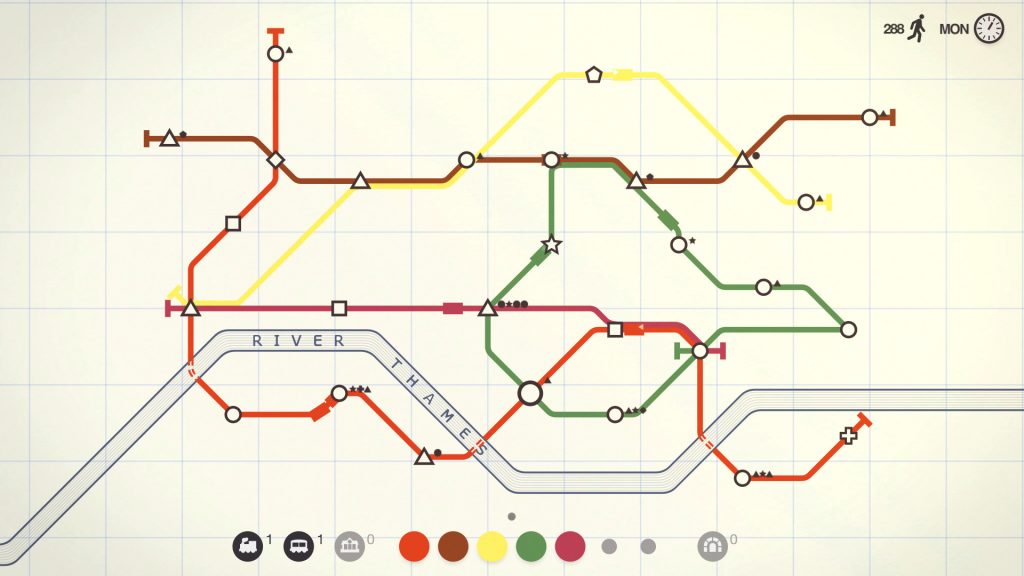
Quick answer: The Paris map in Mini Metro is built around the Seine, which enters the board, bends through the centre and leaves again. That curve creates a compact, dense core surrounded by a looser ring of stations, and crossings are needed at several different points rather than at one. Build a strong central interchange early, and treat each bend of the river as its own crossing problem.
What makes the Paris map distinctive
The Seine does not run straight across this board. It curves, which means the water separates the city into irregular pieces rather than two clean halves. A crossing that works for one part of the map often does nothing for another.
Inside the curve the stations are tightly packed, and that density makes the centre productive for any line that reaches it. Outside, the stations spread out around the edges, so the map has a hot core and a cool periphery that grows over time.
The river also creates islands and inside banks that behave differently from open ground. A station on an island or a narrow bank may have only one sensible route to the rest of the network, which makes it a single point of failure once it starts generating passengers.
All of this adds up to a map that rewards reading the water first. If you understand where the crossings must happen, the lines almost draw themselves. If you ignore the river until a station fills, you will spend tunnels reactively and never quite recover.
On this page
Where the stations cluster
The centre of the board fills quickly and stays busy for the entire run. Stations appear close together there, so a single line can serve many stops, and a single overloaded station can cascade into the ones around it.
Outside the centre the pattern is looser. Stations appear with more distance between them, which makes outer lines cheap in stops but slow in travel. That slowness is what lets a platform fill while the train is still on its way back.
The ring between the two zones is where most runs are decided. It is busy enough to need service and distant enough that service is expensive, and it is usually the last part of the map to receive attention.
New stations appear progressively around the edges, and they are easy to neglect because they are visually separate from the dense core. A forgotten outer station is a common cause of defeat on a map that otherwise looked under control.
Crossing the Seine
Because the river bends, you will need more than one crossing over the course of a run. The first tunnel should go where the centre is closest to the opposite bank, since that is where the most passengers will want to travel.
Later crossings should be placed to serve clusters that the first crossing cannot reach cheaply. Scattering tunnels evenly sounds fair but usually leaves two mediocre crossings instead of one strong one and one adequate one.
Island and inner-bank stations deserve special attention. Because they may have only one viable route, a tunnel spent reaching them is often non-negotiable rather than optional, and delaying it is how a quiet station becomes a crisis.
Keep a tunnel in reserve throughout. The moment a station on the far side starts to fill is not the moment to discover that every crossing has already been committed to somewhere less urgent.
Line shapes that work here
A radial structure suits Paris well. Lines running from the dense centre outward cover the busy middle and reach the ring without forcing long detours, and they share the central interchange that demand naturally creates.
A loop around the core is a useful complement, because it connects the radial lines to each other without sending every passenger through the middle. That relieves the interchange, which is usually the first station to overload on this map.
Avoid lines that follow the river without ever crossing it. They look efficient because they sweep past many stations, but they leave the two banks disconnected and concentrate all cross-river demand onto whichever line does cross.
Keep routes short enough to be frequent. Paris is compact, so long wandering lines waste the advantage the map gives you, and a slow line through a dense area is the quickest way to fill a platform.
Trains versus carriages on this map
Paris rewards frequency more than most maps, because the distances are short. A line that completes its loop quickly clears platforms naturally, so adding a train often solves a problem that a carriage would only postpone.
Capacity still matters on the cross-river lines, which are inevitably longer than the central ones. If a line crosses the Seine and serves clusters on both sides, its trains spend real time away from each stop and need to carry more.
The diagnostic is the same as anywhere: watch whether platforms clear between services. If they do, capacity is your constraint. If passengers remain after a train has passed, the line needs to run more often.
Upgrade the line that is currently struggling rather than spreading improvements. On a compact map, one strong line relieves several stations at once, while two half-upgraded lines relieve none of them properly.
Common ways to lose on Paris
The classic failure is a single central station that receives everything. Because the core is dense and every radial line passes through it, the interchange carries more demand than any other stop, and it fails first.
The second is spending tunnels on the first southern station that appears rather than on the crossing the centre actually needs. That leaves the busy crossing unserved and the quiet station connected.
The third is neglecting the ring. Outer stations are less visible and generate less traffic individually, but several of them filling at once is just as fatal as one central failure.
The fourth is building lines that are too long for the map’s scale. Paris is small enough that a wandering route costs you frequency you cannot afford, and slow service is what turns a manageable platform into a countdown.
Frequently asked questions
How many crossings does Paris need?
More than one, because the river bends. Plan for a second crossing rather than assuming the first will serve the whole map.
Why does my central station always overload?
Because every radial line passes through it. Add a loop to connect lines without routing all passengers through the middle.
Are island stations worth a tunnel?
Usually yes, because they often have no alternative route. Leaving them unconnected is a reliable way to lose later.
Is frequency better than capacity here?
Generally yes, because the map is compact. Capacity matters mainly on the longer cross-river lines.
Should I serve the outer ring early?
Serve it before it becomes urgent, but cheaply. A short connection to an existing line is usually enough.
For the systems behind these choices, see the tunnel and overcrowding guides on the Mini Metro hub.
Official game information: dinopoloclub.com.