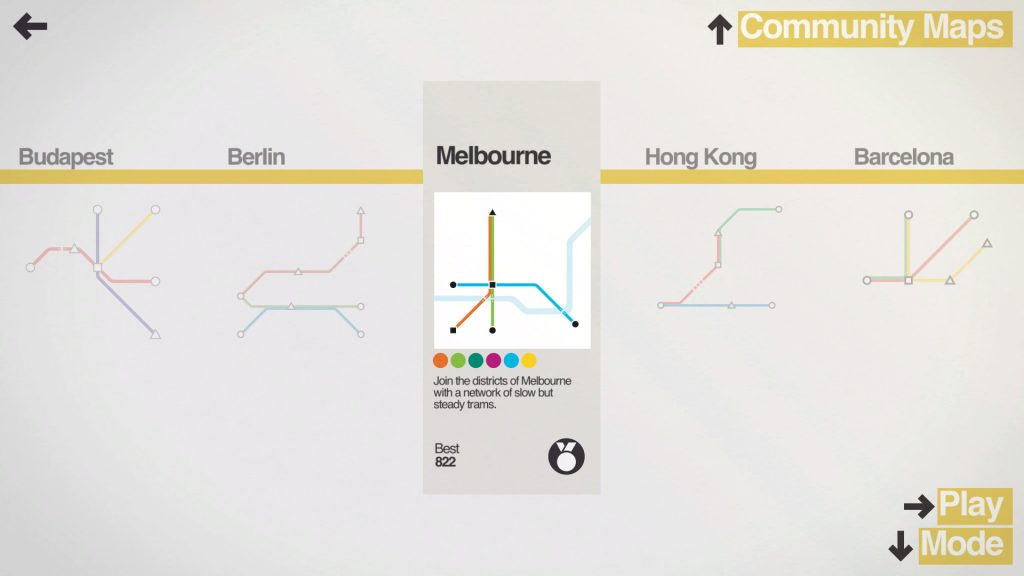
This guide covers mini metro berlin map guide with practical steps for mobile players.
Quick answer: the Berlin map gives you a sprawling city split by a river, with stations spread wide and a few awkward crossings. The reliable approach is to keep one line along each bank and connect them with a small number of crossings, rather than trying to serve everything from a single spine. Build wide before you build clever, and watch the river as much as the stations.
Berlin in Mini Metro is one of the maps that punishes ambition most quickly. The city is large, the stations are scattered, and the river cuts through the middle of your plans.
It also rewards patience. A simple pair of lines that stay on their own side of the water will outperform an elaborate network that crosses twice and clogs at the bridge.
What follows is how to approach it without overbuilding.
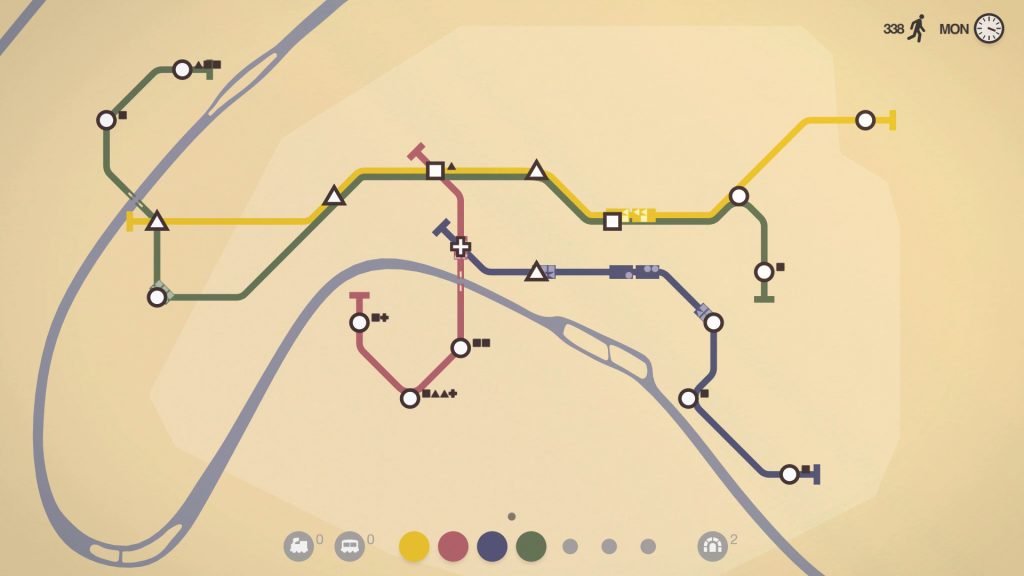
What makes Berlin different?
The river is the defining feature. It divides the map into two halves, and every passenger crossing it must use a bridge or a tunnel.
That turns the crossing points into bottlenecks, because all traffic between the banks has to funnel through them.
Stations on the far side are often further apart than they look, which stretches any line sent to serve them.
The map also tends to open up unevenly, with clusters appearing in one area while another stays quiet.
You will feel the difference within the first minute of play.
Recognising it early is most of the battle.
Everything else follows from respecting the water.
It is also worth noticing how the river bends rather than where it sits. A crossing at a narrow point costs the same as one at a wide point, but serves a shorter path, which keeps your lines tidy.
On this page
How should you lay out your first lines?
Put one line on each bank rather than one line across both.
Each line then serves its own side, and you use a short connector only where traffic actually demands it.
That keeps your crossings scarce, which is what you want.
Two lines that never cross will carry more passengers than one that crosses twice.
Add the connector when a station is genuinely stranded, not before.
Resist the urge to build the full network immediately.
A modest start leaves room to adapt when the map expands.
When the map expands, it tends to do so outward rather than inward, so leave length available on your existing lines. A line already stretched across the city has nowhere to grow.
Where should crossings go?
Put a crossing where several stations cluster on both sides, so one bridge serves many passengers.
Avoid placing it where only two stations benefit, because the bridge will be underused and the line stretched.
Watch which passengers are queueing longest at the bank stations, since those indicate where a crossing would help.
If a bridge starts to jam, that is a sign you need a second one elsewhere rather than a wider one here.
Crossings are cheap to add and expensive to place badly.
Treat each one as a decision about the whole map rather than about two stations.
That framing prevents most Berlin mistakes.
Passengers in Berlin also tend to accumulate on one bank while you are focused on the other. Glance at both sides regularly rather than trusting the side you are currently working on.
How do you handle the busy stations?
Interchanges are the answer, and Berlin gives you plenty of opportunity to use them.
A station served by two lines drains twice as fast as one served by a single line.
Identify the stations that fill most quickly and give them a second line as soon as you can.
That is more effective than adding capacity elsewhere.
If a station is a regular shape, it is a good candidate for a shared stop.
If it is a special shape, it needs a line of its own.
Knowing which is which saves you a lot of rebuilding.
If you are choosing between a new line and a new carriage, take the carriage when your existing lines are well placed. Extra capacity on a good route beats a fourth line that spreads your trains thinner.
How do you use the river tunnels?
Tunnels are your crossings, and you will not have many of them early.
Use them where the alternative is a long detour around the water.
A tunnel that saves a line from running half the map is always worth considering.
Do not spend them on short hops that a bridge position would solve.
Keep one in reserve if you can, because the map expands and new stations can strand a line.
Having a tunnel available when that happens is the difference between adapting and collapsing.
That reserve is worth more than an early convenience.
None of this requires precision. Berlin forgives a slightly untidy network as long as the crossings are sensible and the interchanges exist.
What are the common Berlin mistakes?
One line across the whole city. It will clog at the bridge and starve both banks.
Too many crossings. Each one stretches a line and splits your rolling stock.
Ignoring the far bank. Passengers there pile up until a station overflows.
Overbuilding early. A large network with thin coverage fails faster than a small one with good coverage.
Forgetting interchanges. Single-line stations are the first to overflow.
Most of these come from treating Berlin like a small map.
It is not, and it will remind you.
Play it slowly, add crossings reluctantly, and the map becomes far more manageable than its size suggests.
Frequently asked questions
Is Berlin a hard map?
It is one of the more demanding ones because of the river. It rewards simple layouts over ambitious ones.
Should I connect both banks immediately?
Only where traffic justifies it. One connector early is usually enough.
How many tunnels do I need?
Fewer than you think if your lines stay on their own side. Keep one in reserve.
Do interchanges matter more here?
Yes. The river concentrates traffic, so shared stations drain queues faster.
What should I do when a station overflows?
Add a line to it rather than lengthening an existing one. The queue is a frequency problem.
For more, see managing overcrowded stations and using tunnels. More coverage is on the Mini Metro hub.
Official game information: dinopoloclub.com.