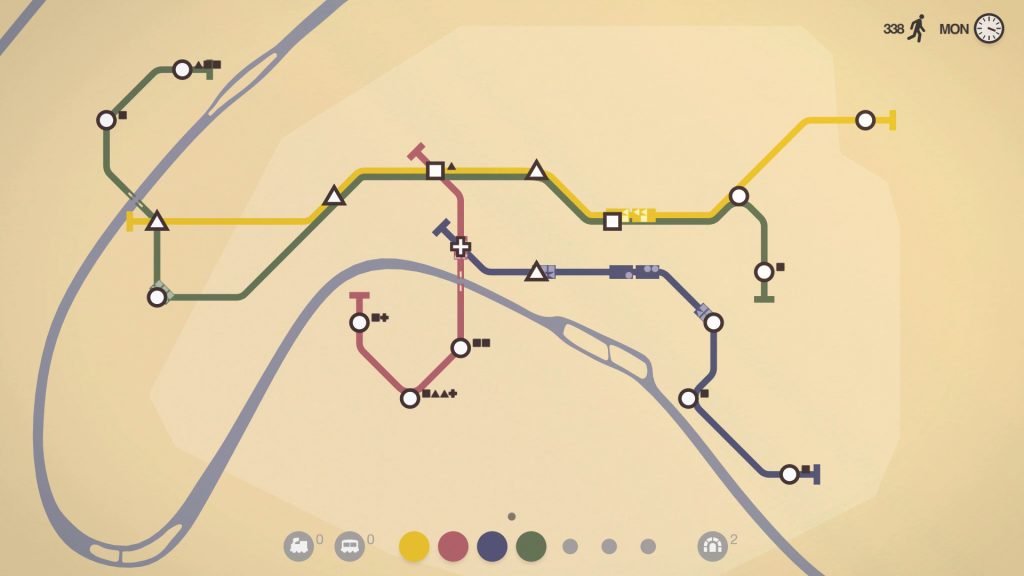
This guide covers mini metro montreal map guide with practical steps for mobile players.
Quick answer: Montreal is an island map with a dense centre and long approaches, where the river wraps most of the city. Build a compact core service, feed it from short outer branches, and spend crossings only where traffic on both banks justifies them. The map rewards concentric thinking rather than long through-routes.
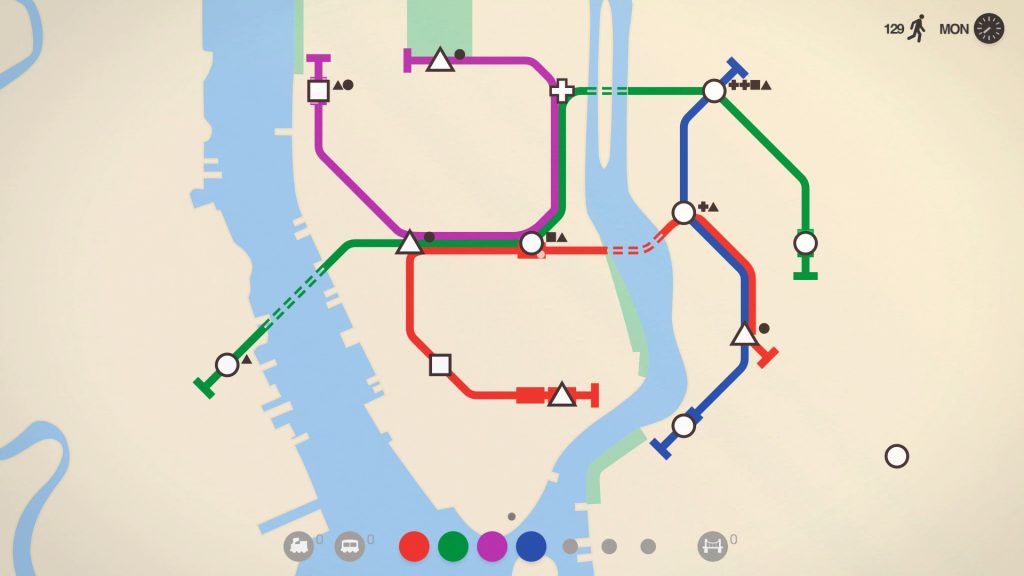
What makes Montreal distinctive
Montreal sits on an island, which means the water is not a line across the map but a boundary around it.
That changes how you think about crossings. Instead of one river to cross, you have a perimeter that constrains where new stations can appear.
Growth tends to happen outward from the centre, following the shape of the land rather than spreading evenly.
The result is a map that starts compact and gradually becomes a ring of outer stations around a dense middle.
That is a comfortable shape to manage, as long as you keep the core fast.
If the core becomes slow, the whole network suffers, because everything eventually passes through it.
So the map asks a simple question: how fast can you keep the middle moving?
Answer that well and Montreal is one of the gentler maps in the game.
Answer it badly and the outer ring starves the centre.
On this page
Building a fast core
Start with a tight loop or a short through-route in the densest part of the city.
Keep it short enough that a train completes a circuit quickly, because frequency is what clears platforms.
As stations appear inside the core, add them only if the detour is small.
Not every nearby station belongs on the main circuit.
If a station would lengthen the route noticeably, serve it from a branch instead.
That keeps the core fast while still collecting the outlier.
Watch the core’s cycle time rather than its length.
If a train is taking noticeably longer than it used to, the line has grown too big to do its job.
Split it at that point rather than extending it again.
It also helps to notice how the map opens up. Early on, growth feels local and the core is easy to manage, but the outer stations arrive faster than the centre grows, so your attention has to shift outward over time.
Expect the middle third of a run to be the busiest. That is when the ring is filling but your core lines have not yet been split, and it is where most runs are lost.
Handling the outer ring
Outer stations appear gradually and are tempting to connect immediately.
Resist that until several appear in the same direction.
A single outlying station rarely justifies a route of its own.
A cluster does, because one branch can serve the whole group.
Watch the perimeter of the map rather than the middle, since the middle usually looks after itself.
When an outer station starts filling consistently, that is the signal to build a feeder.
Feeders can be short and slow without harming the core, because they only need to reach the nearest interchange.
That separation is what keeps Montreal stable late into a run.
Keep the ring outside and the core inside, and the map behaves.
Where crossings belong
Because the water surrounds the city rather than dividing it, crossings are less frequent than on other maps.
Spend them where a cluster across the water is genuinely busy.
A crossing to a quiet shore is a tunnel you will not have when the map grows.
If you are unsure, wait until the far side has two or three stations before committing.
By then the decision is obvious.
Keep one tunnel in reserve where you can.
The later stages can open directions that were not previously reachable.
A spare crossing at that point is worth more than any early convenience.
Tunnels are insurance here as much as infrastructure.
If you find yourself constantly redrawing the same line, that is a sign it is trying to do two jobs. Splitting it into a core route and a feeder usually solves both problems at once.
Interchanges and upgrades
Montreal’s concentric shape produces natural interchange points where feeders meet the core.
Those stations fill quickly because they collect from the outer ring.
Give them a second line before they become a problem, and they will drain fast.
Because the core lines are short, extra trains are usually the better purchase there.
Feeders, which are longer and slower, benefit more from capacity.
Mixing those two up produces a network that looks well supplied and still overflows.
Watch where passengers queue after a train has passed.
The platform tells you which upgrade you need.
Reading it is faster than any rule of thumb.
Common Montreal mistakes
Letting the core grow too long. It slows everything downstream.
Connecting single outer stations. Wait for a cluster before spending a line.
Crossing to quiet shores. Wastes a tunnel that later mattered.
Buying carriages on short core lines. Frequency matters more there.
Watching only the centre. The outer ring is where runs end.
Most of these come from treating Montreal as a spread-out map.
It is a compact map with a wide edge.
Keep the middle fast, feed it from outside, and it stays comfortable for a long time.
The shape of the map is the strategy.
None of this requires precision, and Montreal forgives a slightly untidy network as long as the centre stays quick.
Frequently asked questions
Is Montreal a hard map?
It is below average in difficulty if you keep the core short. It punishes slow centres more than wide edges.
Should I use a loop or a through-route?
A loop works well in the dense core. Through-routes suit the feeder branches better.
When should I connect outer stations?
When two or three appear in the same direction, or when one starts filling consistently.
How many tunnels do I need?
Fewer than on divided maps. Keep one in reserve and use the rest only for busy shores.
Why does my core line keep overflowing?
Probably because it has grown too long. Split it and serve the far half from a branch.
For more, see choosing weekly upgrades and using tunnels. More coverage is on the Mini Metro hub.
Official game information: dinopoloclub.com.