This guide covers mini metro santiago map guide with practical steps for mobile players.
Quick answer: The Santiago map in Mini Metro runs along a valley with a mountain edge, giving you a long narrow corridor rather than an open plain. That shape rewards a few strong lines running the length of the city instead of many short ones scattered across it. Build along the corridor, keep your trunks frequent, and treat the edges as later additions.
It also means your trains spend most of their time travelling rather than loading, which makes frequency the thing worth buying.
A quick way to test whether a proposed line fits the map is to ask whether it shortens the longest journey. If it does not, it is probably a cross-link the city does not need.
What shape does Santiago give you?
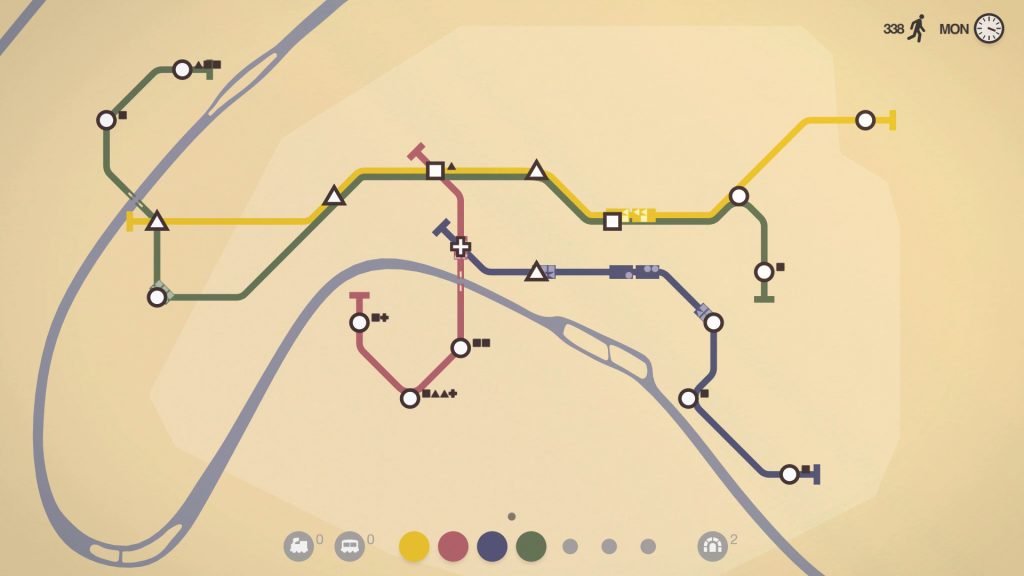
Stations spread in a long band rather than a circle, with the terrain limiting how far the city extends sideways. You are working in a corridor, not a blob.
That changes the geometry of every decision. A line that runs along the corridor serves many stations cheaply, while two lines running across it serve few.
The map rewards thinking in terms of direction rather than in terms of clusters.
Players who build as though the city were square waste track on cross-links that carry almost nobody.
Read the shape first, then build to fit it, and the map stops feeling awkward and starts feeling like a straight problem with a straight answer.
Watch the platform crowding on each trunk. If one side fills while the other stays clear, shift a train before adding a line.
On this page
How many trunk lines should you run?
Two is usually right: one serving each side of the corridor, with interchanges where they meet. That covers the length without duplicating effort.
Three becomes useful once the city has grown enough to justify the extra coverage, but not before you can staff them.
A single trunk is fragile. One overloaded station on it backs up the whole line.
Two trunks give you the option to shift traffic between them when one side fills.
That redundancy is worth more than the extra reach a third line would give, because a network that survives one failure lasts longer than one that reaches further.
| Layout | Strength | Weakness |
|---|---|---|
| One long trunk | Simple, few resources | Fragile at any single station |
| Two parallel trunks | Redundancy, good coverage | Needs two sets of trains |
| Many short lines | Flexible locally | Poor at crossing the city |
| Ring around the edges | Coverage of outliers | Slow for through traffic |
An interchange at a junction of a branch and a trunk is often more valuable than one at the midpoint, because branches otherwise strand their passengers.
Two interchanges on a long corridor are usually enough. More than that splits attention without improving through journeys.
Where do interchanges belong on a corridor map?
Put them at the midpoint and at any point where a branch leaves the trunk. Those are the places where passengers need to change direction.
In a long city, the midpoint matters more than the centre of population, because it is where the two halves of the corridor meet.
A single interchange there lets a passenger travel the whole length with one change, which is exactly what the map requires.
Without it, cross-city journeys demand a detour, and the passengers waiting for one build up.
Place the first interchange early rather than retrofitting it later.
Keep branch lines short. A single-station spur costs one train and clears that platform without touching the trunk timetable.
If an edge station starts crowding, it is cheaper to extend a nearby branch than to reroute the trunk that already works.
How do you serve the edges?
Late, and cheaply. An edge station is worth a short branch from the trunk rather than an extension of the trunk itself.
A branch that adds one station and returns is far cheaper in travel time than rerouting the trunk to include it.
If an edge station has a rare shape, it becomes worth more, because those passengers have to travel further.
That is the moment to consider a dedicated connection, not before.
Edge stations that generate ordinary shapes can wait indefinitely without much cost.
Resist the temptation to add a third trunk early. Three understaffed lines serve the city worse than two well-run ones.
Carriages are worth more here than on circular maps, because a full train on a long corridor spends a long time before it returns.
Which upgrades fit this map?
Trains first, because long trunks need frequency to stay useful. A second train on a corridor line halves the wait along its whole length.
Interchanges next, since the map’s geometry makes transfers unusually valuable.
Carriages once the trunks are frequent and still filling.
Lines only when you have a genuine uncovered section rather than a capacity problem.
Tunnels are rarely the constraint here, which frees choices for the things that matter.
The sixth is forgetting that the map keeps growing along its length. Stations appear at both ends, so the corridor gets longer, not wider.
The seventh is never removing a line that has outlived its purpose. Editing is free, and a stale cross-link occupies a slot you could reuse.
What are the common Santiago mistakes?
Building as though the map were circular is the first, which produces cross-links that carry nothing. The second is running a single trunk and letting one station throttle the whole city.
The third is extending the trunk to reach edge stations instead of branching. The fourth is neglecting interchanges in a city whose whole problem is distance.
The fifth is taking lines as upgrades when trains would have improved the trunks you already have.
Santiago rewards a simple plan executed well. Two frequent trunks and a couple of interchanges will outlast a complicated network built to cover everything.
Frequently asked questions
Is Santiago a long map?
Yes. It runs as a corridor, so travel time matters more than coverage area.
How many lines should I use?
Two well-run trunks usually beat three thin ones. Add a third once you can staff it.
Do I need tunnels?
Rarely. The terrain constrains the city more than water does.
Where should the first interchange go?
Near the midpoint of the corridor, where the two halves meet.
Should I serve isolated stations early?
No. Branch to them later, and only when their shape is worth the trip.
For map strategy, see the Mini Metro hub.
Official game information: dinopoloclub.com.