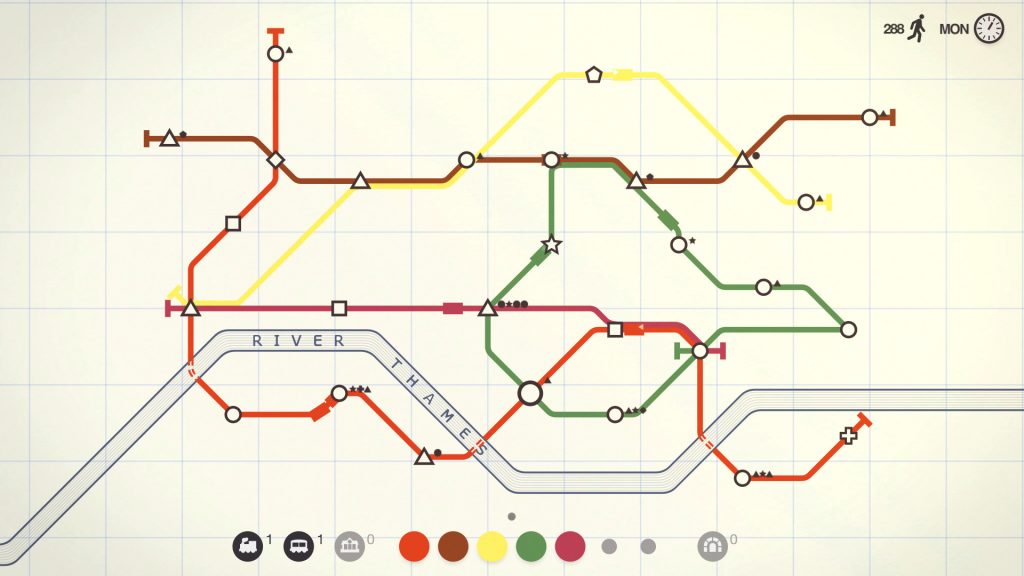
This guide covers mini metro how to manage overcrowded stations with practical steps for mobile players.
Quick answer: Stations overcrowd when passengers arrive faster than trains can clear them, and a station that stays full for too long ends the run. Fix it by adding capacity on the line serving it, adding a second line that reaches it, or using an interchange so passengers can transfer instead of waiting for one route. Prevention beats reaction: watch the stations that fill first and treat them as the priority.
It also helps to remember that demand grows over time. A station comfortable in the first minute may not be comfortable in the tenth.
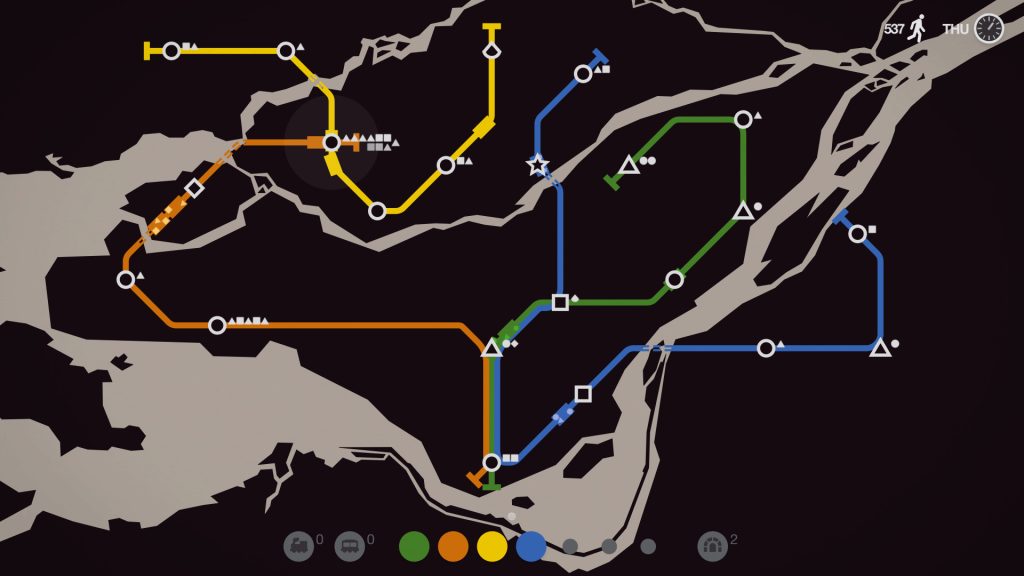
Why do stations overcrowd?
Because demand outpaces service. Passengers spawn at a rate the game controls, while your ability to move them depends on how often a train arrives and how many people it can take.
A station with three shapes and one slow line will fill no matter how many trains you own elsewhere. The problem is local, not global.
Overcrowding is rarely sudden. It builds over a minute or two while the warning ring grows, which means there is almost always time to react if you are watching.
That makes attention as important as resources. A player who scans the map regularly catches problems while they are still fixable.
A player who looks only when something feels wrong often looks too late.
Train yourself to look at the map whenever you make a change, since that is when new pressure appears.
On this page
How do you spot it before it is fatal?
Watch the station symbols rather than the lines. A station that is filling shows a ring, and the ring closing is the countdown you have left.
Scan the whole map every so often rather than staring at one corner. The stations that kill runs are usually the ones you were not looking at.
Pay particular attention to stations with rare shapes. Star, diamond, and cross stations generate passengers who must travel further, which means they wait longer.
Also watch interchanges. They concentrate traffic by design, so they fill faster than their surroundings and fail more visibly.
If you find yourself surprised by a failure, the scan is the habit to build.
| Symptom | Cause | Fix |
|---|---|---|
| One station filling, others clear | Line frequency too low | Add a train to that line |
| Several stations filling along one line | Line too long | Shorten or split the line |
| Interchange filling | Too much traffic routed through it | Add a second route |
| Rare-shape station filling | Passengers travel further | Dedicated connection or interchange |
| Everything filling at once | Network-wide capacity | Carriages and more trains |
A useful rule is to try the cheapest change that touches the crowded station, and only escalate if the ring keeps closing.
Which fix should you apply first?
Add a train to the line serving the station. It is the cheapest intervention and it halves the wait on that route immediately.
If the line already has several trains, adding another helps less because they queue behind each other. At that point the line is saturated and the answer changes.
Add a carriage next, if the trains are full on arrival. A larger train clears a platform in one visit that a smaller one cannot.
Only then consider a new line. Lines are the most expensive resource and the least reversible, so they should be the last answer rather than the first.
Working in that order solves most overcrowding with the resources you already have.
Check how many stations the line serves before adding anything. Long routes fail in a way that extra trains cannot repair.
When should you reroute instead?
When the line is doing too much. A route that serves twelve stations and crosses the map will always be slow, no matter how many trains you put on it.
Shortening the line so it serves fewer stations makes every remaining station better served, at the cost of the ones you removed.
Those removed stations then need another line, which is where a second route earns its place.
Splitting a long line into two shorter ones is usually better than adding trains to it, because it fixes the underlying geometry rather than compensating for it.
That is the moment when a new line is genuinely the right answer.
Short lines also make editing cheap. When a route is five stations long, rerouting it hurts less than rerouting a trunk that half the map depends on.
How do you prevent it structurally?
Keep lines short from the beginning. A compact network with several short routes is more resilient than one long trunk, because a problem stays local.
Place interchanges where traffic concentrates, so passengers can change direction without you extending a line to serve every destination.
Serve rare-shape stations deliberately rather than incidentally. Those passengers are the ones who wait longest, so they are the ones who overflow first.
And leave one resource in reserve when you can. An unused train or line in hand is what lets you respond to a crisis instead of watching it happen.
Prevention is mostly about not overextending, which is the same lesson as everywhere else in the game.
The sixth is reacting to the loudest problem. The station flashing most urgently is not always the one that will end the run.
What are the common mistakes?
Watching the lines instead of the stations is the first. Lines look busy and healthy while a station behind them quietly fills.
The second is adding a new line when a train would have solved it. The third is adding trains to a line that is already saturated, which achieves very little.
The fourth is ignoring rare-shape stations until they overflow. The fifth is leaving no reserve, so a fixable problem becomes terminal.
Overcrowding is the whole failure condition of the game, so everything else in the network exists to prevent it.
Frequently asked questions
What happens when a station fills completely?
A countdown begins. If it runs out before the station clears, the run ends.
Can I pause to think?
Yes, in normal mode. Use it when a station is close to failing.
Do interchanges reduce overcrowding?
Yes. They let passengers transfer rather than waiting for a single route to serve them.
Should I always add trains first?
Usually, unless the line is already saturated. Then shortening it helps more.
Why do rare-shape stations fail first?
Their passengers travel further, so they wait longer and accumulate faster.
For network management, see the Mini Metro hub.
Official game information: dinopoloclub.com.