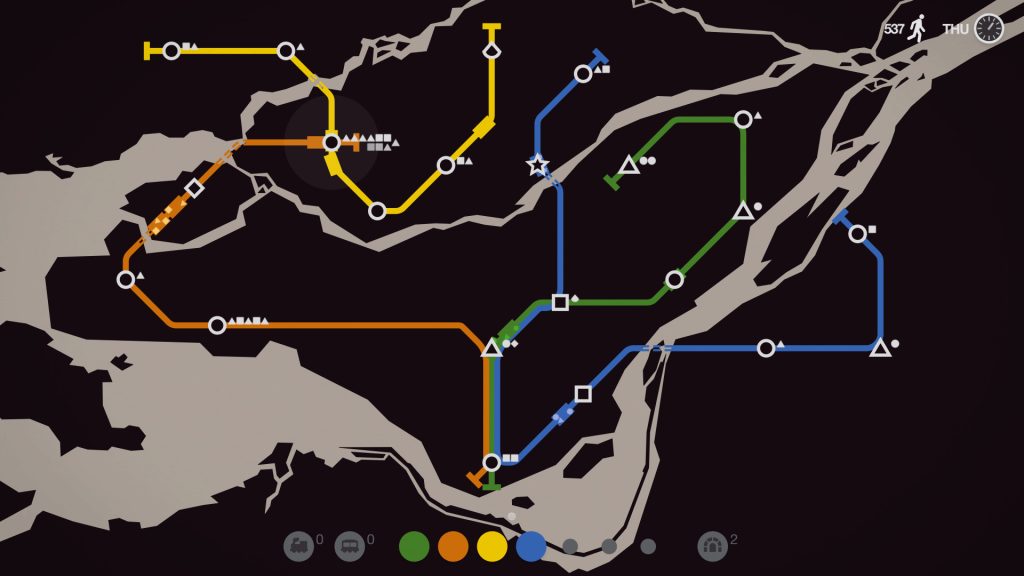
This guide covers mini metro how to choose weekly upgrades with practical steps for mobile players.
Quick answer: Choose weekly upgrades in Mini Metro by picking whichever resource relieves your current bottleneck rather than whichever looks most powerful. If trains are full, take a carriage; if a station keeps filling, take a train; if a whole area is unserved, take a line. Keep one option in reserve when you can, and treat interchanges as valuable whenever they appear.
The offer also changes as the run progresses, with later upgrades tending to matter more as the network grows.
What upgrades are available?
The game offers lines, trains, carriages, tunnels, and interchanges, presented as a choice between two or more when an upgrade arrives.
Each solves a different problem. Trains increase frequency, carriages increase capacity per train, lines extend coverage, tunnels allow river crossings, and interchanges let passengers change routes.
Because the choice is exclusive, taking one means forgoing the other. That makes the decision about what you need rather than what you want.
The offers are partly random, which adds a second layer: sometimes the ideal choice simply is not presented.
In that case, take the one closest to solving your current problem.
Look at the same station twice rather than once. A platform that is fuller the second time is the one to act on.
That two-look habit catches problems that a single glance misses, because crowding is a trend rather than a state.
On this page
How do you read your current bottleneck?
Look at where passengers are waiting. If platforms are full and trains arrive with space, you need more frequency, which means trains.
If trains arrive already full, the problem is capacity, which means carriages.
If an entire region has no line at all, coverage is the gap, which means a line.
If a river separates two busy areas, tunnels become the constraint.
Those four signals cover almost every situation, and reading them correctly is most of the skill.
| Signal | Bottleneck | Upgrade |
|---|---|---|
| Trains arrive with space | Frequency | Train |
| Trains arrive full | Capacity | Carriage |
| Area unserved | Coverage | Line |
| River splits demand | Crossing | Tunnel |
| Passengers change routes often | Transfers | Interchange |
Frequency is also the only fix that helps without any downside. A second train cannot make a line worse, which is why it is a safe default.
Coverage and capacity both carry trade-offs that trains do not, so they reward more thought.
That is also why experienced players take trains early and rarely regret it, while carriages are taken only when the evidence is clear.
Which upgrades are usually best?
Trains are the safest default, because frequency helps everywhere on the line they join and rarely makes anything worse.
Interchanges are the highest-value option when they appear, because they multiply the usefulness of every line you already have without adding track.
Carriages are excellent when your trains are full but poor when they are not, so they depend entirely on the situation.
Lines are powerful but expensive to use well, since a new line also needs trains to run on it.
Tunnels are essential on river maps and nearly worthless elsewhere.
Watch how often you actually use the reserve. If it sits unspent for several minutes, you were being too cautious.
Reserve is insurance, not a strategy. Insurance you never claim is just cost.
Should you keep an upgrade in reserve?
Yes, when the game lets you. An unspent upgrade is flexibility, and flexibility is what turns a crisis into a manageable problem.
If you have a spare train available when a station starts filling, you can respond immediately instead of waiting for the next offer.
The same applies to lines. Holding one lets you react to a new cluster of stations rather than watching it grow unserved.
That said, hoarding everything is its own mistake. An unused upgrade for several minutes is capacity you did not use.
The balance is to hold one and spend the rest.
A useful tiebreaker is to imagine the map two minutes from now. Whichever option would help then is usually the right pick.
That forward look stops you optimising for a moment that has already passed.
How do you decide when the offer is bad?
Take the least-bad option rather than skipping. Upgrades do not accumulate indefinitely, and passing on one usually means waiting longer for the next.
If both choices solve nothing, take the one that would be useful soon. A tunnel on a map with a river will matter eventually even if you do not need it now.
Check what your network lacks structurally rather than only what it needs this minute.
A slightly early investment in coverage is better than a fully wasted choice.
That is the difference between planning and reacting.
The sixth is never looking at what you already own. A spare train sitting unused while you take another train is a wasted choice.
Check your reserves before choosing, because the answer may already be in your hand.
The seventh is choosing by what the network looks like rather than what it does. An elegant map that cannot clear its platforms is still a losing one.
What are the common upgrade mistakes?
Taking a line when a train would have fixed the problem is the first, and it creates a route you cannot staff.
The second is taking carriages on lines whose trains are not full. The third is ignoring interchanges because they do not look like capacity.
The fourth is hoarding upgrades until they are no longer relevant. The fifth is choosing by habit, taking the same option every time regardless of what the network needs.
Upgrades are the only lever the game gives you, so every choice is worth a moment rather than reflex.
Frequently asked questions
Are upgrades random?
Partly. You are usually offered a choice, but not always the one you wanted.
Should I always take trains?
No. Trains fix frequency, not coverage or river crossings.
When are carriages best?
When trains arrive full. Otherwise they add capacity you are not using.
Are interchanges worth taking?
Usually yes, because they improve every line that touches them.
Can I save an upgrade?
When the game allows it, yes. One in reserve is useful; several is waste.
For upgrade strategy, see the Mini Metro hub.
Official game information: dinopoloclub.com.