This guide covers mini metro how to use tunnels with practical steps for mobile players.
Quick answer: In Mini Metro, tunnels are what let a line cross water. Without one, a line cannot reach the far bank, so on river maps tunnels are the resource that decides what your network can do at all. Spend them where the demand on both banks is strongest, and remember that crossing is only worth it if the stations on the far side justify the trip.
How do tunnels actually work?
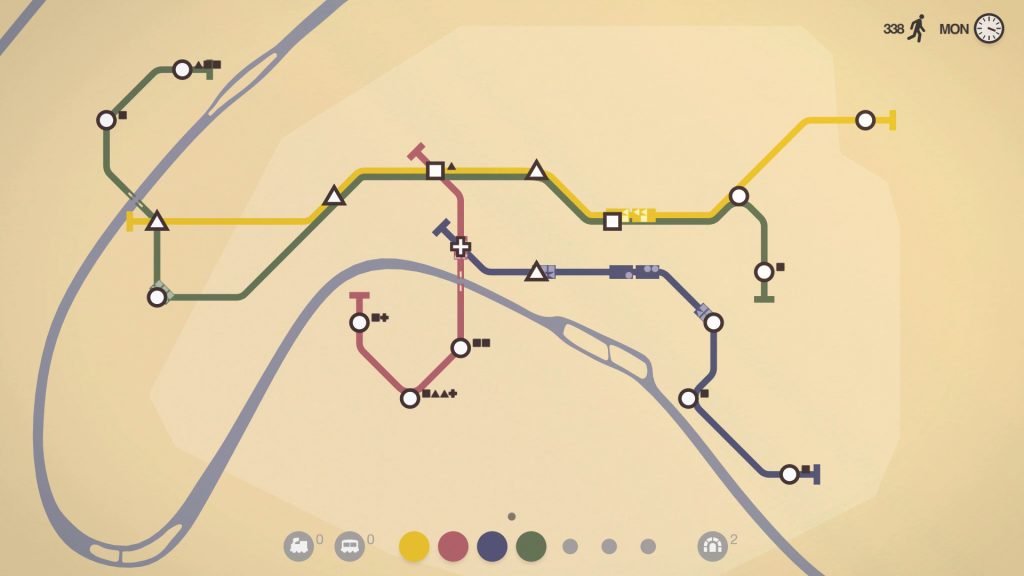
A line cannot cross a river unless one of the tunnels is assigned to that crossing. When you draw a route over water, the game consumes a tunnel from your supply.
Tunnels are limited and arrive through upgrades, which means every crossing is a decision you cannot easily reverse.
On maps without water, tunnels are irrelevant. On maps with a major river, they define everything.
That makes them situational rather than universally important, and reading the map tells you which case you are in.
Spending them on the wrong map is not possible, but spending them badly on the right one is easy.
A quick way to judge a crossing is to imagine walking it. If you would hesitate, the line will too.
Crossings that look obviously useful from a glance are usually the right ones, because the map is designed to be readable.
On this page
Where should the first tunnel go?
At the narrowest crossing with the most demand on both sides. Narrow means the line spends less time over water, and demand means the crossing is actually useful.
Look for two dense clusters facing each other across the river. That is the crossing that repays the tunnel immediately.
Avoid crossing where one side is empty. A tunnel to a handful of stations costs the same as a tunnel to a busy district, and returns far less.
Wait a minute before committing if you can. The map reveals its shape quickly, and a slightly later decision is usually a better one.
The first crossing is the most consequential choice on these maps.
| Crossing type | Value | Notes |
|---|---|---|
| Narrow, dense both sides | Highest | The obvious first tunnel |
| Wide, dense both sides | Good but slow | Long water crossing costs travel time |
| Narrow, sparse one side | Low | Rarely worth a tunnel |
| Multiple crossings | Splits capacity | Two thin links beat neither |
| No crossing | Zero | Stable but limited |
Count the passengers waiting at each end before adding a second crossing. If one end is clear, the first crossing is not yet saturated.
That count is more reliable than intuition, especially once the map is busy.
How many crossings do you need?
Usually one strong crossing early, then a second once the first is saturated. Two well-placed crossings are better than four thin ones.
Each crossing costs a tunnel and, more importantly, adds travel time to the line that uses it. A line that crosses water and then continues far inland is slow for everyone on it.
Use crossings as links between local networks rather than as parts of a long trunk.
That structure lets one tunnel serve two efficient systems instead of one slow route.
Interchanges at each end multiply the benefit, because passengers can transfer without the crossing line going everywhere.
It is worth remembering that a tunnel spent is gone. If you are unsure, waiting costs only time, while a bad crossing costs the resource.
Patience at that moment is usually rewarded within a minute or two.
When should you avoid crossing?
When the far bank has few stations. The tunnel would serve a handful of passengers while the near bank waits for capacity.
When you have no trains to staff the crossing line. A tunnel without a train is an expensive piece of nothing.
When the crossing would make an already long line longer. Length is the enemy of frequency, and the tunnel adds to it.
When you can serve the far bank another way, such as an existing route that already reaches it.
Skipping a crossing is a legitimate strategy that keeps the near bank strong.
The best crossings look almost boring. A short line between two hubs that runs constantly is worth more than an ambitious route that never quite keeps up.
Elegance in this game is measured in cleared platforms, not in how the map looks.
How do you make a crossing efficient?
Keep the line short on both sides. A crossing that immediately continues for many stations takes too long to return.
Put interchanges at each end so passengers can transfer to local lines instead of riding the crossing route across the whole city.
Give the crossing line enough trains. It is usually the busiest line you have, and it deserves the resources.
Watch the stations at each end particularly closely, since they accumulate passengers from both directions.
An efficient crossing looks like a short shuttle between two hubs, not a trunk across the map.
The sixth is treating tunnels as a limited resource to hoard. On a river map, an unspent tunnel is a whole part of the city you never reach.
Hoarding them is worse than spending them imperfectly, because the unserved bank keeps generating stations.
What are the common tunnel mistakes?
Crossing at the first opportunity rather than the best one is the first. The second is using a tunnel on a route that then runs the length of the map.
The third is crossing to a sparse bank. The fourth is building a crossing and forgetting to staff it.
The fifth is neglecting interchanges at the crossing points, which leaves one tunnel doing work that transfers could share.
Tunnels are the clearest example of the game teaching through constraint. One resource, one decision, and the whole map changes shape around it.
Frequently asked questions
Do all maps need tunnels?
No. Only maps with water require them. On others the upgrade is close to worthless.
Can I remove a tunnel?
You can reroute the line, but the tunnel is consumed. Treat each one as permanent.
Should I cross early?
Only when both banks have demand. Otherwise build density on one side first.
Are two crossings better than one?
Usually one strong crossing, then a second when the first saturates. Four thin ones are worse.
Do crossings slow trains down?
The extra distance does. That is why the crossing should be as short as possible.
For map strategy, see the Mini Metro hub.
Official game information: dinopoloclub.com.