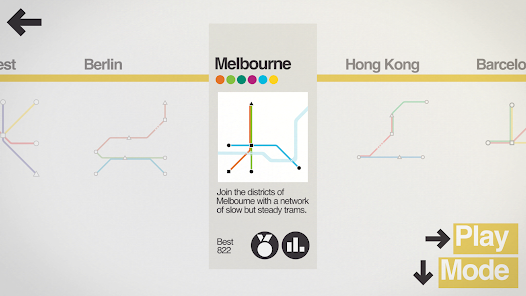
This guide covers mini motorways how to use endless mode with practical steps for mobile players.
Quick answer: Endless mode in Mini Motorways removes the fixed weekly structure and lets you keep building for as long as the network holds, with upgrades arriving as you continue rather than at a set end. Play it to practise layouts without the pressure of a defined run, and treat it as a sandbox for testing how a map behaves under long-term growth.
Endless mode is the closest thing the game has to a practice space. The core rules are the same, but the run does not have the shape of a scored attempt, which changes how you approach the layout. It is where you find out whether a design actually holds up over time.
What is different about endless mode?
The structure is open rather than finite. You keep playing as the city grows, rather than working toward a defined end.
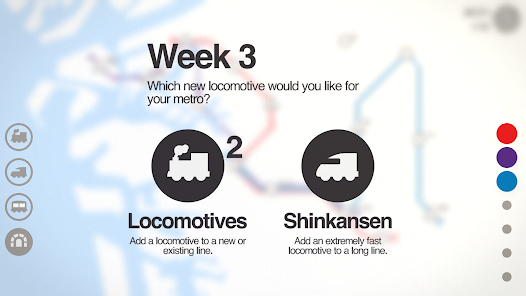
Upgrades still arrive, so the economy of choices remains, but the pressure of a scored run is removed.
That makes it the right place to experiment. You can try a layout that seems questionable and find out whether it holds.
It also makes it a good place to learn a new map before attempting a serious run on it.
On this page
Why play endless mode?
To learn a map’s geography. Every map has a shape that constrains the network, and endless mode lets you find it without losing a scored attempt.
To test a layout idea. If you think a separated network works better than a dense one, endless mode is where you can prove it to yourself.
To practise junction decisions. Controls are the hardest part of the game to get right, and endless mode gives you room to experiment.
To relax. The game is pleasant to build in, and endless mode removes the timer pressure that makes a scored run tense.
How should you play it?
Pick one idea and test it. A run where you try a single hypothesis teaches more than one where you build without a plan.
Rebuild freely. Endless mode is where demolition costs nothing but time, so a tangled network is an opportunity rather than a failure.
Note what fails and why. The value of endless mode is diagnostic, and the lessons transfer directly to scored runs.
Try the same map more than once with different approaches. Comparing two layouts on identical geography is the clearest way to learn.
Do not worry about how long you last. The mode is not scored, and treating it as a competition misses the point.
What should you learn from it?
How a map’s geography shapes the network. A river map and an open map require completely different approaches.
Where the bottlenecks form. Every map fails at predictable points, and endless mode shows you those points without cost.
Which upgrades matter. Some maps are won with bridges and others with road tiles, and testing tells you which.
How much separation helps. A layout with fewer connections usually outperforms a dense one, and endless mode lets you see the difference.
Those four lessons are the whole of the game’s strategy, and each is easier to learn here than in a scored run.
How does it differ from a scored run?
A scored run has a defined shape and a score at the end. Endless mode does not, which changes what you optimise for.
In a scored run you play to last as long as possible. In endless mode you play to understand.
That means different decisions are correct. A risky layout that teaches something is worth trying in endless mode and not in a scored attempt.
The skills transfer, though. What you learn about a map applies directly when you return to a scored run.
Treat the two as different activities rather than as easy and hard versions of the same one.
What are the common endless mode mistakes?
Playing it exactly like a scored run is the first. It removes the pressure without using the freedom.
Not testing anything specific is the second. A run without a hypothesis teaches less than one with.
Never rebuilding is the third. The mode exists to let you try things, and a tangled layout is the chance to do it.
Treating survival as the goal is the fourth, which turns a practice space into a worse scored run.
Forgetting to apply the lessons is the last. What you learn here is worth nothing if you do not use it on the next serious attempt.
Frequently asked questions
Is endless mode scored?
It is not a scored run in the same sense. The emphasis is on continued building rather than on a final result.
Do upgrades still arrive?
Yes. The choice structure remains, which is what makes it useful for practising decisions.
Should beginners start here?
It is a reasonable place to learn a map, though a few scored runs teach the pressure of the timer.
Can I use it to test layouts?
Yes. It is the best place in the game to test an idea without risking a scored attempt.
Does it help with scored runs?
Yes, if you treat it as practice. The geography and bottlenecks are identical.
For the upgrade side, read how to choose weekly upgrades, or return to the Mini Motorways hub.
Official game information: dinopoloclub.com.