This guide covers mini motorways gameplay overview with practical steps for mobile players.
Quick answer: Mini Motorways is a minimalist road-planning puzzle game where you draw roads to connect coloured houses to matching destinations, and the run ends when too many deliveries arrive late. Each week you choose an upgrade such as road tiles, a bridge or a roundabout. It is calm, short-session friendly and surprisingly difficult once the city grows.
The game strips the city builder down to one decision: where does the road go. There is no economy to balance, no zoning and no residents with opinions. There are houses, there are destinations, and there is a limited supply of road with which to join them.
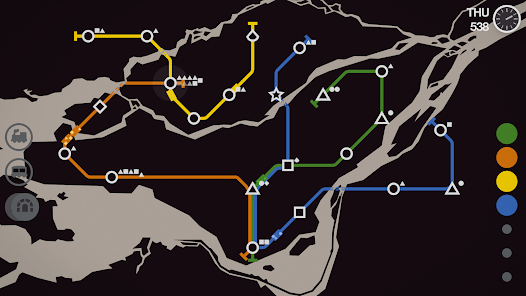
What do you actually do in Mini Motorways?
You draw roads between houses and destinations of the same colour. Vehicles then travel those roads automatically, and each completed delivery is one less thing to worry about.
When a destination waits too long for a car, a timer fills. Fill it completely and the run ends.
Your only tools are roads and a small set of upgrades. That constraint is what makes the game a puzzle rather than a simulation.
The whole experience is drawing lines and watching the consequences.
On this page
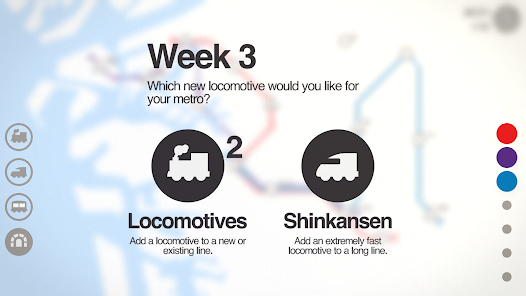
How does the weekly upgrade work?
Every week you choose one upgrade from a small selection: road tiles, a bridge or tunnel, a roundabout, traffic lights or a motorway.
That choice is the game’s only long-term decision. It determines what you can build and therefore what problems you can solve.
Choosing badly does not end the run immediately; it makes the next few weeks harder. That delay is what makes the decision interesting.
Most of the strategy in the game lives in this weekly choice.
Why does it get hard so quickly?
Because the city grows and the road budget does not grow with it. Every new house adds trips, and every new destination adds demand.
The network that worked at week five becomes the bottleneck at week fifteen, and the fix usually requires demolishing something you built.
Traffic also interacts in ways that are hard to predict. Two roads that each worked alone can conflict when joined.
The difficulty is entirely spatial, which is why it feels fair even when it is punishing.
What makes it different from other city games?
It has no economy, no population and no services. There is nothing to balance and nothing to upgrade beyond the road itself.
That reduction is the design. By removing everything except routing, the game makes a single decision carry all the weight.
It is also session-friendly. A run takes minutes, and there is no state to remember between sessions.
Those qualities make it unusually easy to pick up and unusually hard to put down.
Is it difficult?
Early maps are gentle and late maps are not. The difficulty curve is really a geography curve: open maps forgive, and river or corridor maps do not.
There is no fail state beyond the timer, so a bad run costs minutes rather than progress.
That makes it a good game to learn by losing, which is fortunate because losing is how most of the learning happens.
Most players improve quickly once they stop building roads everywhere and start thinking about trips.
Who is it for?
Players who like spatial puzzles, minimal design and short sessions with a clear failure state.
It is less suited to players who want a builder with depth, progression or a story. There is none of any of those.
It is well suited to playing in short bursts, because a run has a natural length and nothing carries over.
If that sounds appealing, the game delivers it very cleanly.
One thing that surprises new players is how quickly the game stops being about connecting things and starts being about the order in which traffic uses them. A network where every road is correct can still fail because the vehicles conflict at one junction.
It also surprises people that the fix is often to remove a road rather than add one. Fewer connections mean fewer places for traffic to meet, and that is frequently the whole solution.
Finally, the game is unusually honest about failure. When a run ends, the cause is visible on the map, and the lesson is usually obvious in hindsight rather than mysterious.
The maps are the content, and each one is a different puzzle rather than a different difficulty. An open map teaches restraint and a river map teaches crossings, and neither lesson is much use on the other.
That is why players who master one map often struggle on the next. The skills transfer slowly, and the geography has to be learned separately each time.
It is also why the game rewards playing the same map repeatedly. Familiarity with where the districts appear is worth more than any general principle.
Frequently asked questions
Is Mini Motorways a city builder?
Only loosely. It is a road-routing puzzle with a city theme rather than a management simulation.
How long does a run last?
Usually minutes. Longer runs happen as you improve, but the game is built for short sessions.
Can you lose?
Yes. A run ends when the delivery timer fills, though a lost run costs only the time you spent.
Is there a story?
No. The game is purely mechanical, with no narrative and no characters.
Do I need to play the original Mini Metro first?
No. The games share a design philosophy but teach themselves separately.
For the basics, read the weekly upgrade guide, or return to the Mini Motorways hub.
Official game information: dinopoloclub.com.