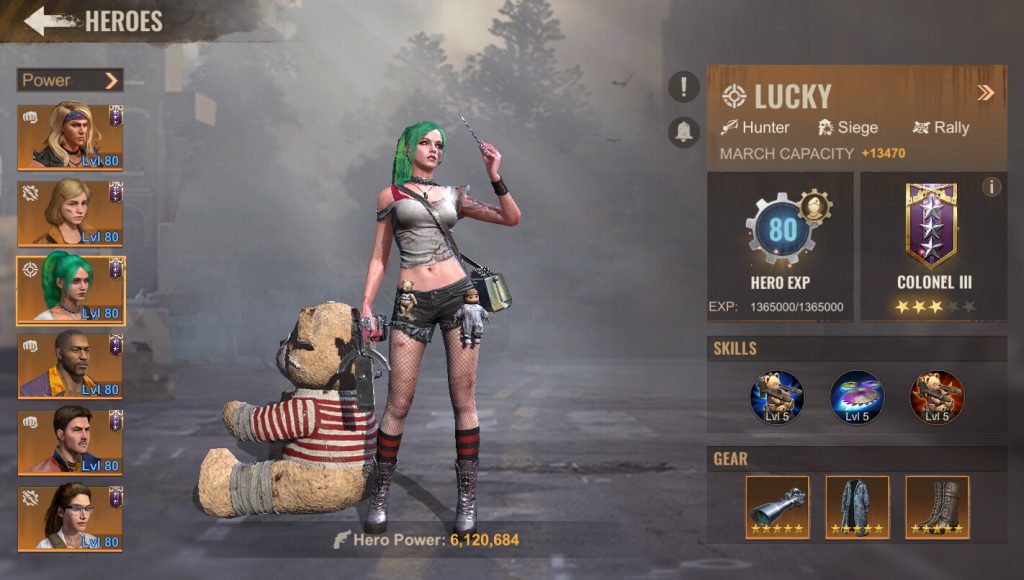
This guide covers state of survival how to improve hero skills with practical steps for mobile players.
Quick answer: Improve hero skills by focusing on a few heroes rather than levelling everyone, upgrading the skills that match how you actually use them, and keeping each hero’s star level and skill level moving together. A hero with high stars but untouched skills underperforms a lower-star hero whose skills match their role in your army.
How do hero skills actually work?
Each hero has skills that do different jobs. Some boost the troops they lead in a march, raising attack, defence or health for a specific troop type. Others trigger during battles as active effects. A third group improves what the hero does in exploration, where you fight with heroes rather than an army.
Because the effects differ by context, a skill that looks weak on the hero screen can be valuable in the mode you play most. Read what each skill applies to before deciding it is not worth the materials.
Skills also scale with the hero’s investment level. Upgrading a skill on a hero you never deploy is wasted material, while the same material spent on your main march leader shows up in every fight you take.
On this page
Which heroes should you invest in?
Pick two or three heroes and treat them as your core. Investment in this game is a funnel, and a deep funnel on a small set produces far more power than a shallow spread across a roster you do not use.
Choose heroes whose bonuses match the troop type you are strongest in. If your research and training have gone into ranged troops, a hero that buffs ranged troops multiplies that investment, while a hero for another troop type fights against it.
Also consider how you get their upgrade materials. Heroes whose fragments and skill materials come from content you actually complete will progress faster than a theoretically better hero you can never upgrade.
How do you upgrade a hero skill?
Skill upgrades need materials earned from events, exploration and daily activity. The requirement rises with each level, so the last few levels of a skill are expensive and should only go to heroes you are certain about.
Upgrade in order of impact rather than order of appearance. A skill that affects every march you send is worth more than one that only applies to a specific situation you rarely encounter, even if it is listed first.
Keep a buffer of materials instead of spending them the moment you get them. Events occasionally require hero-related actions for points, and having materials on hand lets you complete those objectives without extra spending.
How do hero fragments fit in?
Fragments raise a hero’s star level, which raises their base stats and unlocks or improves their skills. Star level is therefore the foundation, and skill upgrades sit on top of it. A hero stuck at low stars has a low ceiling no matter how many skills you upgrade.
Fragments come from events, alliance activities and specific reward tracks. Because the sources are limited, choosing which hero receives them is a real decision rather than a formality, and spreading them across five heroes usually leaves all five too weak to matter.
The exception is heroes used only for exploration, where hero level and skills matter more than army bonuses. Even there, a focused pair will outperform a scattered roster, because exploration rewards depth over breadth.
How should you build a hero for your troop type?
Match the hero to the troops they will lead. The front line wants a hero whose skills reduce incoming damage, the ranged line wants damage and critical bonuses, and mounted troops want mobility and burst effects.
Then check the hero’s own troop-type specialisation. A hero whose bonus applies to a type you do not field contributes much less than one aligned with your research, and that mismatch is the most common reason a well-upgraded hero underperforms.
Finally, consider pairings. Heroes that reinforce each other’s strengths used together in a march can be worth more than improving either one alone, so build around a combination you actually send out.
What mistakes waste hero investment?
The biggest is upgrading skills before stars. Because skills scale from the hero’s base power, pouring materials into a low-star hero gives you a fraction of the benefit you would get after raising their star level.
The second is chasing a hero because they are new. New heroes are usually released with content built around them, which makes them look essential, but an established hero you can actually upgrade will carry you further for less.
The third is ignoring exploration heroes entirely. Exploration is a steady source of materials, and a neglected pair of exploration heroes means slower access to everything else you are trying to upgrade.
Frequently asked questions
Should I level every hero I unlock?
No. Levelling is cheap but upgrading is not, and materials spent on heroes you never deploy are materials you cannot spend on your core.
Do hero skills affect my whole army?
They affect the troops the hero leads in a march, and some apply in exploration. Check what each skill states before assuming it is global.
Are stars or skills more important?
Stars first, because they raise the base that skills scale from. Skills are the multiplier on that foundation.
How do I get more materials?
Events, alliance activities, exploration progress and daily objectives. Consistency matters more than any single big reward.
Is it worth switching my main hero later?
Only for a clear upgrade you can actually fund. Abandoning an invested hero for a better one you cannot upgrade usually loses you power.
Match hero choice to your army with the troop and research guides on the State of Survival hub, and see the hero fragment guide for where the star upgrades come from.
Official game information: funplus.com.