This guide covers mini metro beginner guide with practical steps for mobile players.
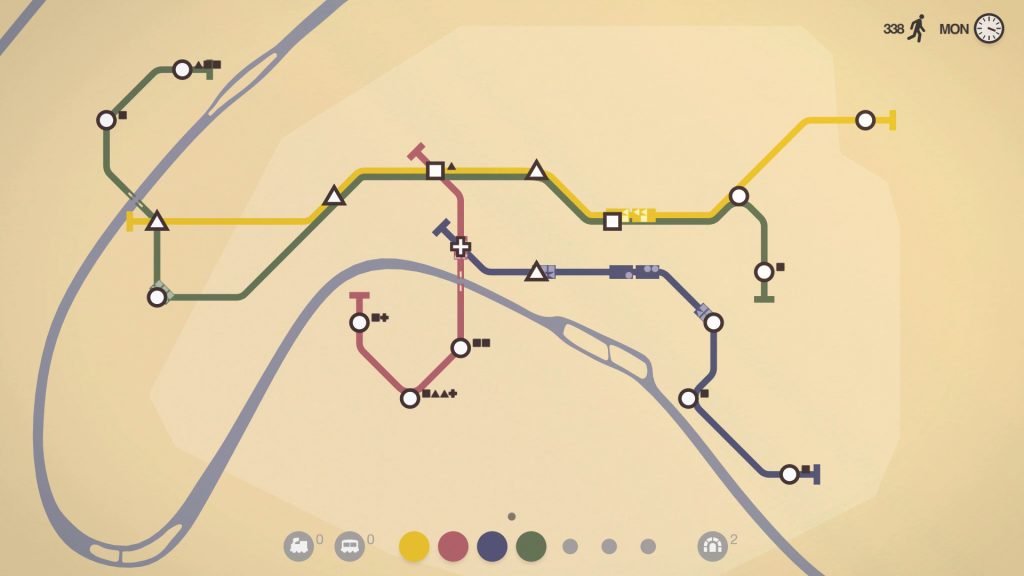
Quick answer: Mini Metro is a minimalist subway planning game where you draw lines between stations and try to keep a growing city moving. Passengers appear at stations shaped as circles, triangles and squares, and each one wants to reach a station of the same shape. Your job is to connect those shapes efficiently, because when any single station fills up and stays full, the run ends. Everything else in the game follows from that one rule.
What kind of game is Mini Metro
Mini Metro is a mobile planning game about drawing metro lines on a growing map. There is no driving, no timetables and no individual passengers to click. You place lines, add trains and watch the simulation run, adjusting as the city expands around you.
The presentation is deliberately spare. Stations are simple shapes, trains are short lines that move along your routes, and passengers are tiny markers waiting on the platform. That minimalism is functional rather than stylistic, because it lets you read the whole network at a glance when a problem starts.
The game is played in short sessions that can last minutes or much longer depending on how well you manage growth. A run ends when a station overcrowds, so the tension is not about speed but about staying ahead of demand. You are not racing a clock, you are racing the city itself.
What makes it compelling is that the rules are almost trivially simple while the situations they generate are not. You will lose runs and understand exactly why, which is the mark of a design that respects the player. Every failure teaches something specific rather than feeling arbitrary.
It also works well in small doses. Because a run can end quickly, the game fits into a commute or a coffee break, and because a good run can last a long time, it rewards the sessions where you have more attention to give. That flexibility is a large part of why people keep returning to it.
On this page
The three shapes and what passengers want
Every station has a shape, and every passenger is heading for a station of the same shape. A circle passenger wants a circle station, a triangle wants a triangle, and a square wants a square. That single rule is the entire logic of the game, and almost every mistake traces back to forgetting it under pressure.
Early on the map offers only the three basic shapes, so connections are easy to reason about. Later, special shapes appear and they change the calculation, because a passenger heading for a rare shape may have only one possible destination on the whole map. Those journeys are the ones that clog a line if you have not planned for them.
The practical consequence is that you are not connecting stations, you are connecting shapes. Two stations of different shapes on the same line do nothing for each other directly, although they may both feed a shared interchange. Thinking in terms of shapes rather than locations is the mental shift that separates comfortable runs from panicked ones.
It also means duplication matters. If a city has many circle stations and only one triangle, the triangle becomes a destination for a large share of your passengers. A line that reaches it cheaply is worth more than a line that looks balanced on the map but treats every shape as equally important.
When a new station appears, the first question is which shape it is and whether that shape is already well served. If it is, a short connection is often enough. If it introduces a shape that was previously rare or distant, it deserves a more deliberate route rather than a quick link bolted onto an existing line.
Lines, trains and capacity
You start with a small number of lines and gain more as the run develops. Each line is a colour you can redraw freely at any time, which means your network is never fixed and a bad decision can usually be corrected. That freedom is the main tool you have for responding to pressure.
Trains move along lines and pick up passengers up to their capacity. When a train is full, it stops collecting and simply carries what it has, so capacity is a hard limit rather than a soft one. Adding a carriage increases what a train can carry, and adding a train increases how often the line is served.
The choice between more trains and more capacity is the central trade of the game. A long line with many stations benefits from capacity, because each train spends a long time away from any given stop. A short, busy line benefits from frequency, because the wait between trains is what fills a platform.
Line shape matters as much as line length. A line that doubles back on itself wastes travel time, while a line that forms a simple loop or a clean through-route keeps trains productive. Redrawing a line to remove a kink is often more valuable than adding another train to it.
It is also worth remembering that you can move a line rather than extend it. When a station becomes overwhelmed, rerouting an existing line through it is frequently faster than waiting for a new line to become available. That flexibility is easy to forget when you are focused on expansion.
Managing overcrowding before it kills you
Each station has a limit, and when it is exceeded a countdown begins. If the station empties before that countdown finishes, the crisis passes. If it does not, the run ends immediately, regardless of how well the rest of the network is performing.
That asymmetry is what makes overcrowding the whole game. One neglected station can end a run that was otherwise excellent, so your attention has to move constantly rather than settling on the lines you find interesting. The station that kills you is almost always the one you stopped watching.
The earliest warning sign is a platform that stays busy after a train has passed. A station that clears between trains is healthy even if it looks crowded in the moment. A station where passengers remain after a service has been through is telling you that demand exceeds what that line can carry.
Responding early is much cheaper than responding late. A small reroute or an extra train added when a platform first starts to linger will usually solve the problem. The same problem addressed when the countdown has begun requires a fast, drastic change that often destabilises another part of the network.
It also helps to know which stations you cannot afford to lose. Interchanges, rare shapes and stations at the end of long lines are all high risk, because a delay anywhere on the route compounds before help arrives. Watching those specific stations is more efficient than scanning the whole map evenly.
Rivers, tunnels and geography
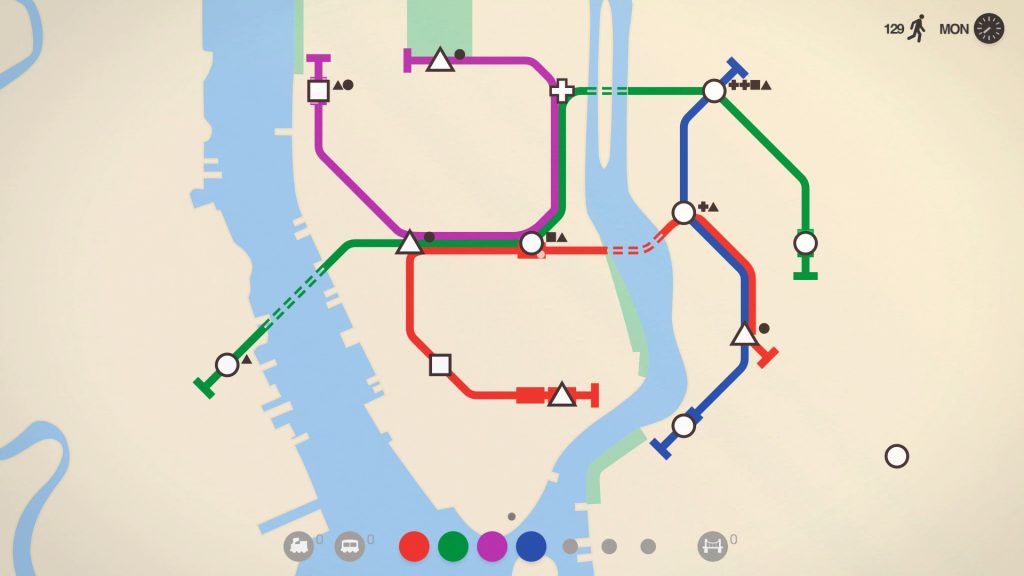
Many cities in the game are divided by water, and crossing it requires a tunnel. Tunnels are a limited resource, so every river crossing is a decision about where you most need to spend one rather than a free connection between two halves of the map.
That scarcity shapes strategy more than the map itself. A city with a single river encourages you to consolidate crossings rather than scatter them, because a line that crosses once and serves both banks is cheaper than two lines that each cross separately. Wasting tunnels early is a common way to stall later.
The same logic applies to any geographic obstacle the game presents. Islands, peninsulas and awkward borders all create the same problem: the natural route is blocked and the alternative costs a resource. Planning around those features before you need to is far easier than improvising when a station on the far side is filling up.
Geography also determines where your interchange stations want to be. A point where several lines must converge anyway is an efficient place to route traffic, whereas a crossing in an awkward location forces passengers to travel further than necessary. Reading the map for natural hubs is a skill worth developing early.
Finally, remember that tunnels are limited but lines are not. Rerouting a line to use an existing tunnel more cleverly is often better than spending a new tunnel to create a second crossing. That kind of redrawing is free, and it compounds over a long run.
How a run ends and what to learn from it
Every run ends the same way: a station overloads and you are shown the network you built. That final picture is the most useful thing the game gives you, because it shows exactly where the pressure accumulated and which part of your design could not cope.
Most losses fall into a few patterns. A line was extended too far and became slow. A rare shape was left poorly connected. A tunnel was spent early and the later crossing could not be made. Recognising which pattern you hit turns a loss into information rather than frustration.
The habit worth building is to name the cause before you restart. Players who restart immediately tend to repeat the same mistake, because the lesson was never articulated. A few seconds of looking at the finished map is usually enough to identify what went wrong.
It is also worth noting that a good run is not one where nothing goes wrong, but one where problems are solved before they become fatal. The network you finish with rarely resembles the one you started with, and that constant adaptation is the actual skill the game is testing.
Because sessions are short, the cost of experimenting is low. Try a different line shape, spend tunnels differently, or favour frequency over capacity, and see what changes. The game is generous enough with restarts that deliberate experimentation is a faster route to competence than cautious repetition.
Frequently asked questions
What actually ends a run in Mini Metro?
A single station staying overcrowded until its timer expires. The rest of the network can be healthy and the run still ends on that one failure.
Do passengers need to reach a specific station?
They need a station of their own shape. Any station matching that shape will do, which is why shape distribution matters more than exact locations.
Should I add trains or carriages first?
It depends on the line. Long lines with many stops usually want capacity, while short busy lines usually want frequency.
Can I redraw lines during a run?
Yes, at any time and at no cost. Rerouting is often the fastest fix for a station that is starting to overload.
Why do I keep losing on maps with rivers?
Usually because tunnels were spent early on convenient crossings, leaving none for the crossing that later became critical.
For city-specific routes and the systems behind them, see the map guides and upgrade guides on the Mini Metro hub.
Official game information: dinopoloclub.com.