This guide covers mini metro new york map guide with practical steps for mobile players.
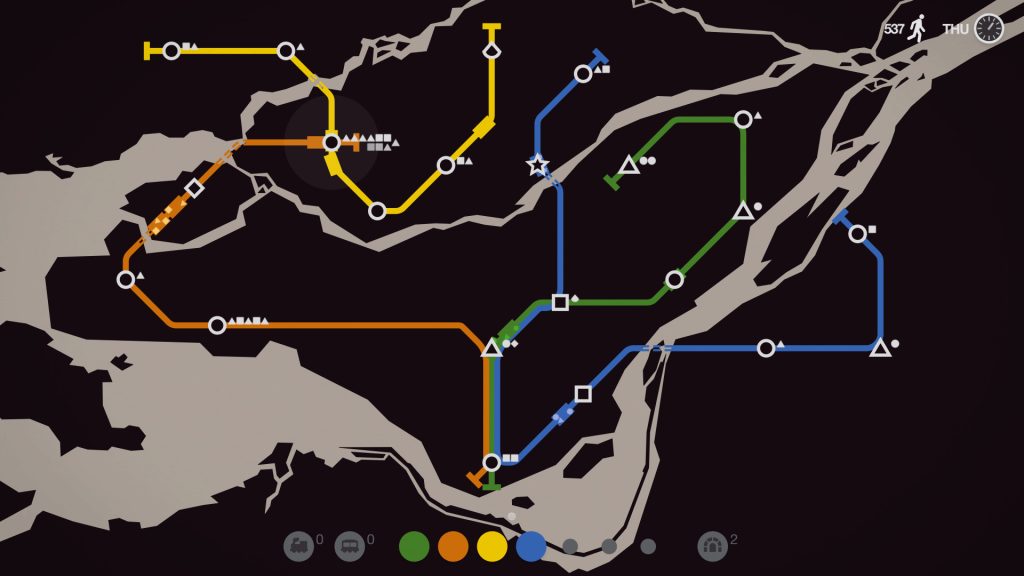
Quick answer: The New York map in Mini Metro is a long strip of stations with water on both sides, which makes it the most linear board in the game. Most of your passengers travel along the island rather than around it, so long north-south lines do the heavy lifting. Crossings to the outer areas are expensive and should be spent deliberately rather than wherever a station happens to appear.
What makes the New York map distinctive
The board is shaped like an island, and that shape dictates everything. Stations line up along a narrow strip rather than spreading in every direction, so travel is mostly along one axis and lines are naturally long and thin.
Water runs along both sides, which means the map has an inside and an outside. The strip is where the density is, and the outer edges are where stations appear later and where every connection costs a crossing.
That combination produces a map with a strong natural corridor. A single line running the length of the island can serve a large share of demand, which makes one well-built spine more valuable here than on any other board.
The risk is that the spine becomes a single point of failure. When most passengers depend on one route, any delay along it fills platforms at both ends simultaneously, and the failure arrives in two places at once.
On this page
Where the stations cluster
Density is highest in the middle of the strip and thins toward both ends. The centre is where lines want to cross, and it is also where an overload does the most damage because neighbouring stations are close enough to be affected.
The ends of the strip are quieter individually but far from everything else. A station at either tip takes a long time to reach, which means its platform has more time to fill between services.
Outer stations across the water appear as the run develops. They are sparse and expensive to reach, and they generate enough demand to matter without generating enough to justify heavy investment.
The practical reading is that the middle of the strip is your priority, the ends need reliable service rather than frequent service, and the outer areas need one deliberate connection each rather than a network.
Crossing the water
Every crossing off the island costs a tunnel, and because the island is long, a crossing at one end does nothing for a station at the other. Placement matters more here than on any other map.
Cross where the outer station is closest to the strip, and where it sits near a part of your spine that already carries traffic. That way one crossing serves both the outer station and the interchange it connects to.
Resist connecting every outer station as soon as it appears. Some are quiet enough to wait, and a tunnel saved for a busier crossing later is worth more than an early connection to a station nobody is using yet.
Keep one tunnel in reserve at all times. The map’s length means a crisis at the far end takes a long time to reach, and having a crossing available is often the only way to respond before the countdown runs out.
Line shapes that work here
A long north-south spine is the foundation. It follows the island’s natural demand and lets a single line serve most of the strip, which is efficient because the map offers few alternative corridors.
Cross-links between the spine and the outer areas are the second layer. They should be short and purposeful, connecting a specific outer cluster to a specific point on the spine rather than wandering along the water.
A second parallel line is worth building once the spine is saturated, but not before. Two half-served parallel routes are worse than one strong route and one short connector, because passengers transfer between them and lose time.
Avoid loops on this map. The strip shape means a loop has to double back along the same corridor, which wastes travel time on a board where travel time is already the main constraint.
Trains versus carriages on this map
New York favours capacity more than most maps. The spine is long, trains spend a long time between stops, and a train that arrives full has effectively failed even if it arrives on schedule.
Short cross-links are the exception. If a connector is brief and busy, adding a train clears its platform faster than adding a carriage, because the round trip is quick enough for frequency to matter.
The general rule is to upgrade whatever is currently holding the most passengers. On this map that is almost always the spine, and almost never the outer connectors.
Watch both ends of the spine rather than only the middle. Because the line is long, a problem at one tip can develop while you are looking at the other, and the two ends fail independently.
Common ways to lose on New York
The first is spreading crossings evenly along the strip instead of concentrating them where demand is. Even placement looks tidy and leaves every outer station under-served.
The second is building a second parallel spine too early. It splits traffic, slows both lines, and leaves you with two mediocre routes instead of one reliable one.
The third is ignoring the ends of the island. They are visually peripheral and easy to forget, but a tip station has the longest journey to any help and the most time to fill.
The fourth is relying entirely on one line. When the spine is your whole network, any delay on it is a network-wide failure, and no amount of capacity elsewhere compensates.
Frequently asked questions
Why is New York so linear?
The board is an island strip with water on both sides, so stations line up along one axis rather than spreading out.
Should I build two parallel lines?
Only once the first is saturated. Two half-served parallel routes are worse than one strong spine with short connectors.
Where should tunnels go?
Where outer stations are closest to the busy part of the strip, so one crossing serves both the station and its interchange.
Is capacity or frequency better here?
Capacity on the long spine, frequency on the short cross-links.
Why do the ends of my line keep filling?
Because they are furthest from help. A tip station has the longest wait between services, so it needs reliable rather than frequent attention.
For the mechanics behind these decisions, see the tunnel and overcrowding guides on the Mini Metro hub.
Official game information: dinopoloclub.com.