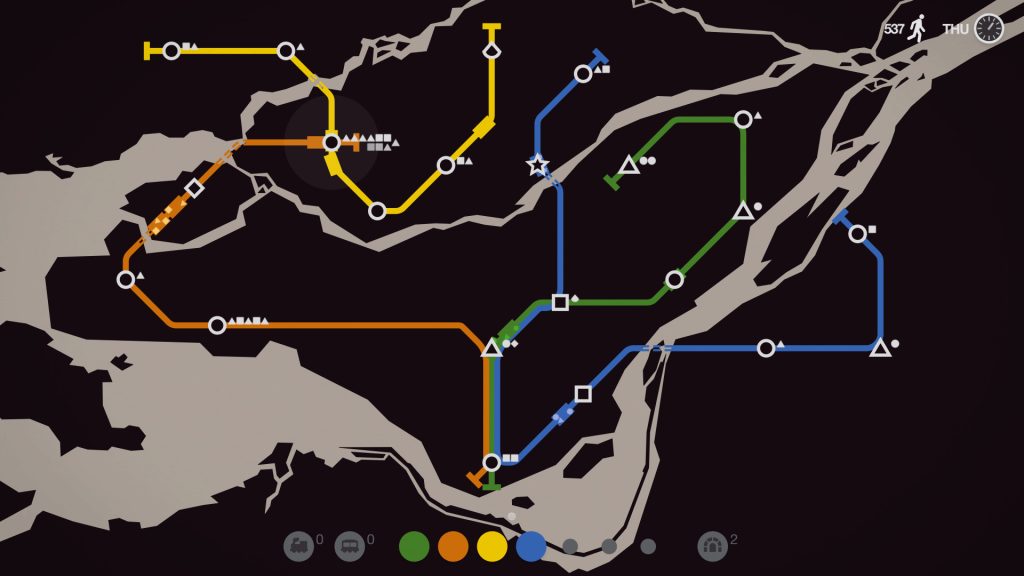
This guide covers mini metro stockholm map guide with practical steps for mobile players.
Quick answer: Stockholm is a map built around islands, so almost every useful connection involves water. The recurring lines here are short and the crossings are precious. Build compact lines on each island, connect them through a small number of well-chosen tunnels, and treat every crossing as a decision about the whole map rather than about two stations.
What makes Stockholm distinctive
Stockholm is an archipelago map. Land is broken into pieces and the gaps between them determine what is possible.
That means your network is less a set of routes than a set of islands connected by a few strategic links.
The consequence is that tunnels are not a convenience here, they are the structure of the map.
Each island wants its own small, fast service that collects passengers and delivers them to a crossing.
Long lines that span several islands look efficient and behave badly, because they spend most of their time crossing water rather than serving stops.
The map rewards consolidation. One good crossing serving two busy islands beats three crossings serving scattered stations.
It also rewards patience. Stations appear gradually, and the island that is quiet now may be the busiest in ten minutes.
Read the map as a shape rather than a list of stations.
That shift is the whole Stockholm skill.
On this page
Opening on the archipelago
Start with a short line on your starting island, covering the cluster densely.
Keep it tight so trains cycle quickly, because frequency is what clears platforms.
As stations appear on the same island, extend that line rather than starting a new one.
Only look across the water when your island is properly served and still has spare capacity.
Crossing early is the most common way to lose on this map.
It stretches your only line across two islands and leaves both served badly.
Wait until a second island has several stations before committing a tunnel.
By then you will know which crossing is worth making.
Patience in the first few minutes pays off for the rest of the run.
Choosing which islands to connect
Connect the island that is busiest now, not the one that looks largest.
Size on the map does not indicate traffic, and a small dense island can generate more passengers than a large sparse one.
Watch where passengers are waiting rather than where the coastline is.
That is the only reliable signal.
Once an island is connected, its own lines should feed the crossing rather than continuing across it.
The crossing exists to hand passengers over, not to be part of a long route.
This keeps the inter-island link fast and the local service independent.
If the link becomes congested, redraw rather than adding a second crossing.
Redrawing is free and usually solves it.
Managing tunnels on a water map
Tunnels are the scarcest resource on Stockholm and the decision that most shapes the run.
Spend one only where both sides have traffic.
A tunnel to a quiet island is a tunnel you will not have when the map expands.
Keep one in reserve for as long as possible, because the later stages can open areas that were not previously reachable.
A spare tunnel at that point is worth more than any early convenience.
Remember that lines can be rerouted freely, so an underused tunnel can be repurposed rather than abandoned.
Move the line through it instead of building a new crossing.
That keeps your crossing count low and your options open.
Tunnels are insurance as much as infrastructure here.
Interchanges and capacity
Because islands concentrate traffic, the crossing points become natural interchanges.
A station where a local line and a cross-island link meet will fill and clear rapidly.
That is healthy, not a problem, as long as both lines are frequent enough.
If a crossing station starts to linger, the fix is usually more frequency on the feeding line rather than more capacity on the link.
Short local lines want extra trains; long links want carriages.
Mixing those up produces a network that looks well supplied and still overflows.
Watch where passengers queue after a train has passed, and let that guide the purchase.
The platform tells you which upgrade you actually need.
Reading it is a faster route to competence than any rule of thumb.
Common Stockholm mistakes
Crossing too early. The most common error and the most damaging.
One line spanning several islands. It becomes slow and depends entirely on tunnels.
Connecting quiet islands. Wastes a tunnel that later mattered.
Adding crossings instead of rerouting. Redrawing is free and usually better.
Ignoring a connected island’s local lines. The crossing cannot carry traffic that never reaches it.
Most of these come from treating Stockholm as one city rather than a set of them.
Think island by island, connect deliberately, and the map stays stable far longer than its geography suggests.
The archipelago is the puzzle, not the obstacle.
Solve it and it becomes one of the most satisfying maps to play.
Frequently asked questions
Is Stockholm a hard map?
It is above average because water constrains everything. It rewards consolidation over coverage.
How many tunnels do I need?
Fewer than you expect if each island feeds a single crossing. Keep one in reserve.
Should I serve every island?
No. Some islands are not worth a tunnel until they have several busy stations.
Why does my cross-island line keep overflowing?
Probably because the local lines feeding it are too slow. Add trains locally rather than carriages on the link.
Can I move a tunnel later?
You cannot move the tunnel itself, but you can reroute the line through it, which usually achieves the same result.
For more, see using tunnels and normal versus extreme mode. More coverage is on the Mini Metro hub.
Official game information: dinopoloclub.com.