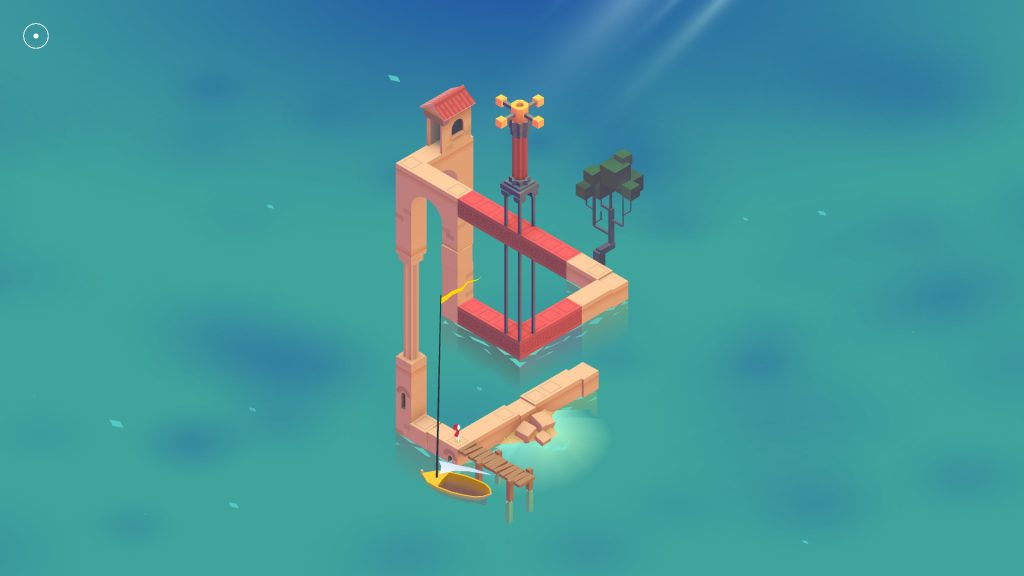
This guide covers monument valley 2 chapter 12 walkthrough with practical steps for mobile players.
Quick answer: Chapter 12 is one of the last scenes before the ending and combines everything: rotation, sliding, motion and dependency. Work in sections, keep the character on solid ground while you rearrange, and expect the final approach to depend on a move you made much earlier. If the chapter feels impossible, you are probably trying to hold every mechanism at once rather than solving one section at a time.
Late chapters in this game are deliberately dense. They are not longer because the puzzles are bigger, but because the same small vocabulary of moves is applied in more combinations, and the scene withholds its shape until you have solved the first third of it.

What should you do in the first minute?
Pan around the whole structure before touching anything. You are looking for three things: where the character starts, where the route appears to end, and which mechanisms exist between them. That survey is the most valuable minute you will spend in the chapter.
Then identify the sections. A dense scene still has natural breaks, usually where the character steps onto a new platform or where the structure changes material or scale. Those breaks are the boundaries of the puzzles.
Finally, pick the section with the fewest unknowns and solve it first. Progress anywhere in a dense scene helps, because it removes a variable from every later section.
On this page
How do you manage a scene with many mechanisms?
Name them to yourself. There is a wheel on the left, a slider at the base, a travelling platform in the middle. Giving them labels stops them blurring into a general impression of complexity, and it lets you reason about one at a time.
Then solve dependencies in order. A mechanism whose output is used by nothing else can be set first and forgotten; a mechanism whose output feeds another has to wait until its consumer is ready.
Check the character’s position before each change. In a scene this dense, standing on the wrong surface is the most common reason a correct arrangement appears not to work.
Why does the chapter seem to hide its route?
Because the structure is designed so that the path only becomes visible once several pieces are in place. That is a deliberate choice rather than an accident, and it is why the early minutes feel unproductive.
The route is not hidden in the sense of being concealed; it is simply not yet true. Once the arrangements are correct, the path appears the way it did in the early chapters, and the scene suddenly looks obvious in hindsight.
That is the intended arc of a late chapter: confusion, incremental progress, then a moment where the whole picture resolves. Nothing before that moment is wasted.
How do you handle the final section?
Expect it to require something from earlier. Late chapters often make the last approach depend on a rotation made near the start, and players who have been tidying their arrangements as they go discover that they removed the thing they needed.
If the final approach will not open, walk back down the route and check the mechanisms you have already used. One of them probably needs to be in a state you have since changed.
Then look at the geometry from the character’s final position rather than from where you began. The view from the top of a structure is often the only place from which the last connection is visible.
What are the failure patterns to watch for?
Thrashing is the first: many changes, no progress. That usually means you are solving a section you have misidentified, so stop and re-survey rather than continuing to adjust.
Over-planning is the second. A scene with four mechanisms has too many combinations to plan in your head, so plan one section and let the rest reveal itself.
The third is assuming a stuck mechanism is broken. In this chapter almost everything is dependent on something else, so a piece that will not move is almost always waiting rather than finished.
What does the ending ask of you?
Nothing new mechanically. The final chapters, this one included, use the same three ideas, and the ending is delivered through the architecture and the story rather than through a final test of skill.
That is worth knowing because it changes how you approach the last scenes. There is no difficulty spike waiting to punish you; there is a sequence of dense puzzles that resolve into the game’s conclusion.
So the right approach is the same one that has worked throughout: look carefully, change one thing at a time, and trust that the route exists once the pieces are arranged.
Dense scenes also benefit from being solved from the outside in. The mechanisms near the character are usually the ones that matter first, and the ones on the far side of the structure tend to matter once the route has advanced. Working outward means each change is made while its effect is still visible, rather than after the character has moved past the part of the building it controls.
If you find yourself repeatedly undoing the same rotation, that rotation is probably correct and something else is wrong. Check the character position, then the dependent mechanism, then the route itself.
The chapter also rewards leaving yourself an escape. If a section fails, the character should be somewhere they can walk back from, and the platforms near the start of each section are the places to keep them until the next arrangement is ready.
Taken slowly, the scene resolves; taken quickly, it produces the impression of a building that will not cooperate.
Keep the route short where you can. A section that needs three separate arrangements is harder than three sections that need one each, and the chapter is built to be divided rather than solved whole.
Frequently asked questions
Is chapter 12 the hardest chapter?
It is one of the densest. The difficulty comes from combining familiar mechanisms rather than from new ones.
Why can I not see the route at the start?
Because it does not exist yet. The path appears once several arrangements are in place.
Should I undo early rotations?
Only if they block you. In late chapters the final approach often depends on something set early.
What if a mechanism will not move?
It is probably dependent on another piece. Set the accessible mechanisms first and return to it.
Does the chapter have a time limit?
No. Nothing in the game is timed, so you can take as long as the scene requires.
Next: the chapter 13 walkthrough, or return to the Monument Valley 2 hub.
Official game information: www.monumentvalleygame.com.