This guide covers monument valley 2 vs monument valley with practical steps for mobile players.
Quick answer: Monument Valley 2 is the sequel, and the difference is mostly one of confidence rather than of mechanics. The first game introduced the illusion puzzles and told a sparse story about a silent princess; the sequel uses the same visual language to tell a story about a mother and daughter, with slightly more varied puzzles and a stronger emotional arc. Play the original first if you want the mechanics to unfold in order; play the sequel first if you only want one of them.
Both games are short, premium and wordless, and both are built on isometric geometry that only makes sense from one angle. The question is not which is better in the abstract but which one suits the experience you are looking for.
What is the same in both games?
The core interaction. You tap to walk and drag to rotate structures, and the puzzle is always about aligning surfaces so a route exists. Neither game introduces a new control scheme beyond that pair.
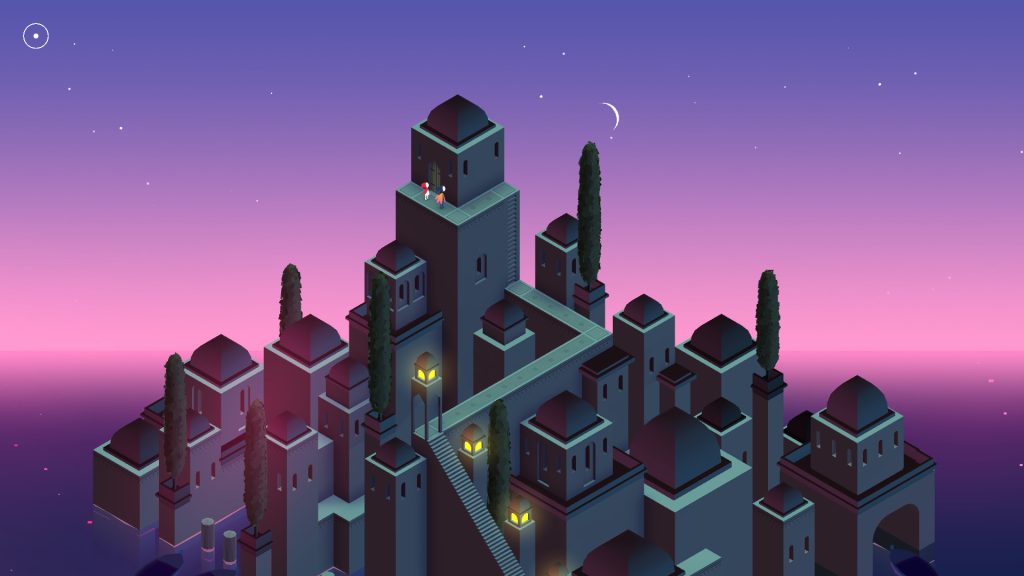
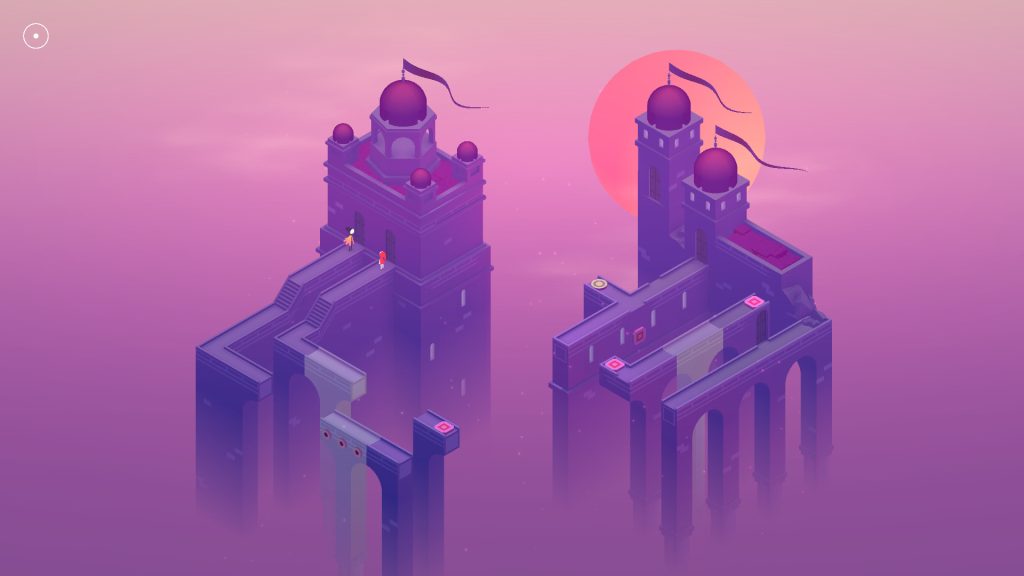
The visual language is also shared: flat colour, clean architecture, a fixed camera and no text. A screenshot from one is immediately identifiable as belonging to the other.
And the structure is the same, a linear sequence of short chapters with no collectibles, no scoring and no way to fail. Whatever you thought of the first game’s pacing, the second one paces itself the same way.
On this page
What does the sequel do differently?
It adds a second character who moves with you and occasionally separates. That sounds like a small change and it has a large effect on the puzzles, because scenes now have to account for two positions rather than one.
It also varies the mechanism set a little more. The sequel is comfortable introducing a moving platform or a chained rotation earlier, on the assumption that you have played the first game or that you will learn quickly.
The story is the bigger difference. The first game is about a solitary figure and a sense of trespass; the sequel is about parenthood and letting go, and the chapter staging is written to serve that.
Which should you play first?
Play the original first if you intend to play both. Its puzzles are the foundation, and the sequel assumes a certain fluency that is easier to acquire in order.
Play the sequel first if you only want one. It is the more polished of the two, its story is more immediately engaging, and it does not depend on knowledge from the first game.
There is no wrong answer, because neither game spoils the other. They share a world and a style rather than a continuous plot, so the order is a matter of preference rather than of continuity.
Is the sequel harder?
Slightly, in places, but not in a way that should worry anyone. Both games are designed to be finished, and neither punishes a wrong move with anything more than a wasted tap.
The sequel’s difficulty comes from layering rather than from new rules. A late chapter might combine rotation, sliding and motion, where the original would have used one of them.
That makes the sequel a slightly better fit for players who have played puzzle games before, and the original a slightly better starting point for someone who has not.
How do the two games compare side by side?
| Aspect | Monument Valley | Monument Valley 2 |
|---|---|---|
| Protagonist | A solitary figure | A mother and her child |
| Story | Sparse, about trespass and release | Warmer, about parenthood and separation |
| Mechanics | Rotation and perspective joins | The same, plus more sliding and motion |
| Difficulty | Gentle throughout | Gentle, with denser late chapters |
| Length | Short campaign | Comparable, with additional content in some editions |
| Controls | Tap and drag | Identical |
| Monetisation | Single purchase | Single purchase |
The table makes the relationship clear: the sequel is an iteration rather than a reinvention, and its improvements are in staging and variety rather than in the underlying design.
Do you need both?
Not strictly. If you play one and want more, the other will satisfy that; if you play one and find it slight, the other will not change your mind.
They are short enough that owning both is not a large commitment, and playing them in order is the more satisfying experience because you can see the design maturing.
What you should not expect is a large jump in scope. The sequel is a refinement of a formula that was already working, and it is honest about that.
The clearest way to feel the difference is to play the same chapter type in both games. Where the original gives you a single rotating structure and a clean route, the sequel tends to give you the same structure plus a second character whose position also matters. That additional constraint is the whole of the mechanical evolution, and it is enough.
It is also worth noting that the sequel was designed for players who had already met the first game. Its opening chapters move faster, its tutorials are lighter, and it trusts you to work out the visual logic rather than demonstrating it at length. For a newcomer that is still perfectly playable, but it explains why the original feels like the more patient of the two.
Both, in the end, are short enough that the comparison is less about value and more about which memory you want to keep.
The simplest way to decide between them is to ask which one you would hand to someone who has never played either. The first is the cleaner introduction; the second is the richer one.
Frequently asked questions
Does the sequel spoil the first game?
No. The stories are separate, and the mechanics are taught independently.
Is the first game still worth playing?
Yes, especially if you want to see where the visual language came from.
Which is longer?
They are comparable. Both are short campaigns measured in hours rather than in tens of hours.
Do either have in-app purchases?
No. Both are single purchases with no currency or level packs.
Can a child play either?
Yes. Neither has text, violence or a failure state.
For the sequel’s chapters, start at the chapter 1 walkthrough, or return to the Monument Valley 2 hub.
Official game information: www.monumentvalleygame.com.