
This guide covers monument valley 2 gameplay overview with practical steps for mobile players.
Quick answer: Monument Valley 2 is a premium puzzle game about guiding a mother and her child through architecture that only makes sense from one viewing angle. You tap to walk and drag to rotate, slide or ride the structures, and the story is told entirely without words. It is short, it cannot be failed, and it has no in-app purchases, which makes it one of the most approachable puzzle games on mobile.
The game belongs to a small genre of titles that treat the screen as an artwork first and a puzzle second. The puzzles are gentle, the pacing is deliberate, and the whole thing is designed to be finished in a couple of sittings rather than maintained as a daily habit.
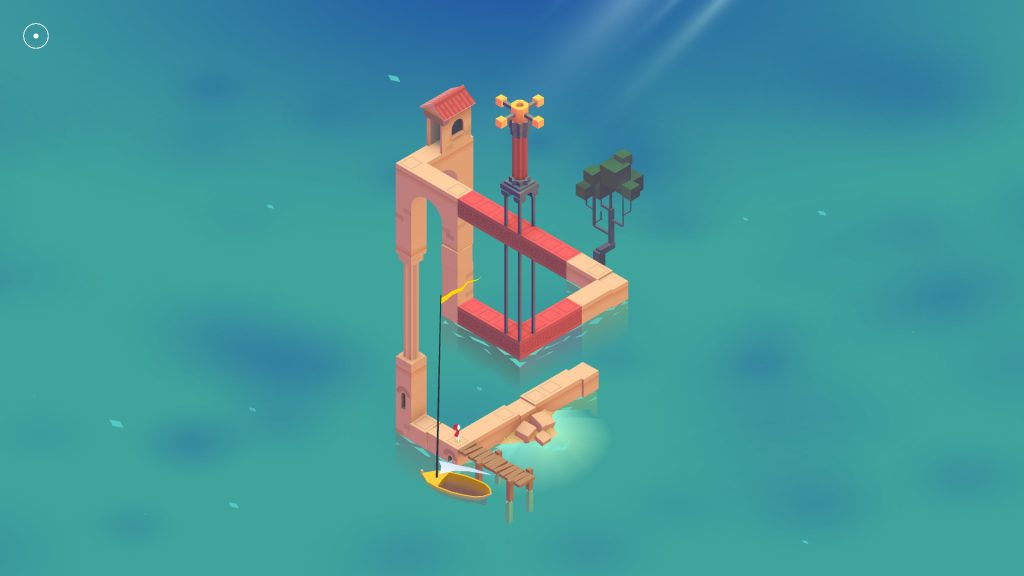
What do you actually do in it?
You move characters through a series of isometric dioramas. Each one is a small building with impossible geometry, and your job is to find the route through it by adjusting the building itself.
The tools are simple. Tapping a point on a path walks the character there. Dragging a wheel, handle or slider rearranges the structure. Some pieces move on their own, and then the puzzle becomes about timing rather than arrangement.
There is no combat, no inventory and no dialogue. The whole interaction vocabulary is tap and drag, which is why the game works equally well on a phone, a tablet and a computer.
On this page
How does the story work without words?
Through staging. A mother and a daughter travel together, then separately, then together again, and the architecture carries the change. Chapters where the pair are close are built differently from chapters where they are apart.
Colour does much of the work. Palettes shift between chapters to signal a change in mood, and the visual style is consistent enough that a shift is immediately readable without any text explaining it.
That restraint is deliberate. Because nothing is stated, the story is available to a very young player and to an adult in different ways, which is a large part of why the game is remembered.
How long does it take to finish?
A few hours. The campaign is a sequence of short chapters, each of which takes minutes rather than tens of minutes, and there is no padding between them.
That length is a design choice rather than a limitation. The game ends when the story ends, and it does not add collectibles or grinding to extend the play time artificially.
The chapters are replayable from a menu once completed, so the total time you spend depends on whether you go back. Most players do, briefly, to show a favourite scene to somebody.
Is it difficult?
No. It is designed to be finished, and the challenge is in noticing rather than in executing. You cannot die, you cannot fail, and a wrong move costs a tap rather than progress.
Some late chapters require a few minutes of thought, particularly those that chain several mechanisms together, but the game never withholds the solution behind precision or speed.
That makes it unusually friendly to players who normally avoid puzzle games, and it also makes it a good game to play with a child, because the frustration that usually ends those sessions does not exist here.
What does it cost and what is included?
It is a single purchase. There are no in-app purchases, no currency, no energy system and no advertising. What you buy is the complete campaign.
The game may also be available through a subscription service on some platforms, in which case access depends on the subscription rather than on a purchase. The content is the same either way.
Additional content, where a release includes it, comes with the game rather than as a separate purchase, so there is nothing to budget for after the initial price.
Who is it for?
Players who like puzzles but not pressure. Players who enjoy architecture, colour and animation. Parents looking for something a child can play without supervision or frustration.
It is less suited to players who want a long campaign, a scoring system or a reason to keep returning. The game is complete when it ends, and it does not pretend otherwise.
If that sounds like a limitation, it is worth reframing: a game that knows when to stop is rare, and this one stops at exactly the right moment.
What the game does unusually well is refuse to pad itself. There is no daily reward, no login streak and no reason to return tomorrow, which in a mobile market is close to radical. The trade is that it will not fill months of your time; the benefit is that every minute of it is deliberate.
It also respects the device it runs on. The interface disappears entirely while you play, leaving nothing on screen but the architecture, which means a phone becomes a window rather than a control panel. That single decision does more for the atmosphere than any amount of graphical fidelity.
If you are deciding whether to buy it, the honest summary is this: it is a few hours long, it is beautiful, it will not frustrate you, and it will not ask you for anything else afterwards.
What makes it endure is that the difficulty never comes from speed or precision. Nothing in the game punishes a slow decision, so the only thing standing between you and the next chapter is the idea itself.
That is rarer than it sounds. Most mobile puzzlers eventually ask for reflexes or for currency; this one asks only that you look at the picture differently.
Frequently asked questions
Is it a sequel that requires the first game?
No. The story is separate and the mechanics are introduced from scratch, so it works as an entry point.
Does it have in-app purchases?
No. It is a single purchase with the full campaign included.
Can you fail or die?
No. There are no hazards, no timers and no way to lose progress.
How long is the campaign?
A few hours, spread across short chapters that can be replayed from a menu afterwards.
Is it suitable for children?
Yes. There is no text to read, no violence and no failure state.
Start with the chapter 1 walkthrough, or return to the Monument Valley 2 hub.
Official game information: www.monumentvalleygame.com.