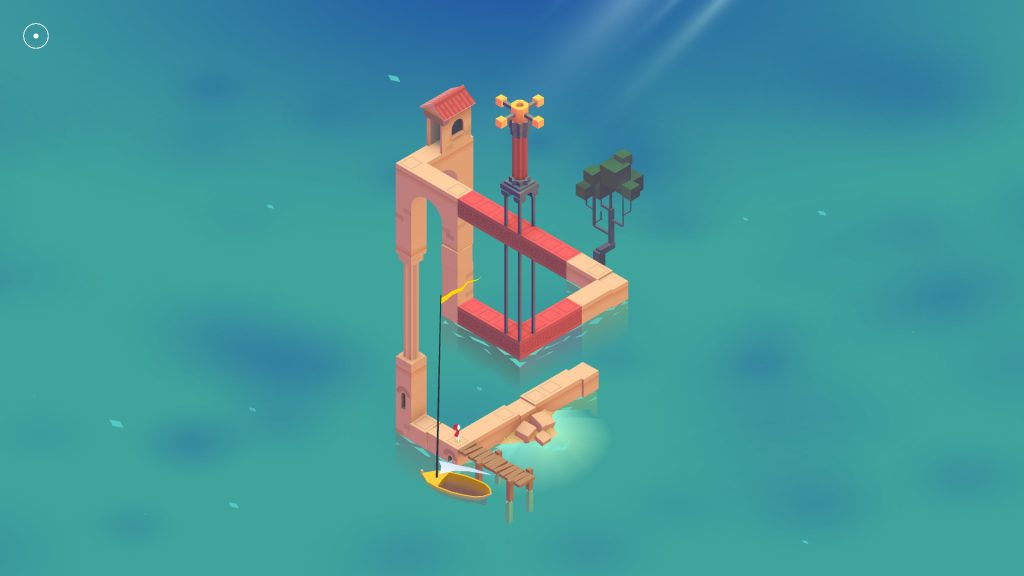
This guide covers monument valley 2 chapter 7 walkthrough with practical steps for mobile players.
Quick answer: Chapter 7 introduces structures where the walking surface itself moves, so the route you build is only valid while the moving part is in the right place. Stand still, watch the motion, and time your tap so the character steps on as the surface arrives. Nothing in this chapter can be failed, so the correct approach is to observe a full cycle before acting rather than to tap and hope.
Until now every change you made was permanent until you made another one. This chapter adds motion that happens without your input, which changes the problem from arranging the world to cooperating with it. That is a meaningful shift, and it is the first time the game asks you to read timing rather than geometry alone.

What is moving in chapter 7?
Platforms and surfaces travel along paths or revolve around joints without any drag from you, and the character can ride them or step onto them as they pass. The route therefore depends on where the moving piece is at the moment you tap, not only on how the structure is oriented.
Some of these surfaces carry the character; others only change what a static path connects to. The distinction matters because a moving surface you can stand on is a route in itself, while a moving surface you cannot stand on is a changing connector between two fixed routes.
Because the motion is continuous, the same arrangement produces progress at one moment and nothing at another. That is the entire chapter in one sentence, and once you accept it the scene becomes readable.
On this page
How do you time a tap correctly?
Watch one full cycle first. Do not touch anything, and let the moving parts complete their motion so you know the pattern, the interval and where each piece returns to. Acting before you have seen a cycle is guessing.
Then tap as the surface arrives rather than after it has arrived. The character begins walking immediately, so a tap timed slightly early means they step on as it reaches them, which is usually the difference between boarding and missing.
If you do miss, the character simply stays where they are and you wait for the next pass. There is no penalty for missing, which is why timing in this game is a matter of patience rather than of reflex.
How does this change how you build a route?
You stop thinking of a route as a thing that exists and start thinking of it as a thing that becomes true periodically. The static parts of the structure define where the character can wait, and the moving parts define the windows during which waiting turns into progress.
That means good places to stand are valuable. A spot where the character can wait safely while you rotate something else is worth more than a spot that only works for an instant, and the chapter is built around using those waiting positions.
It also means you should solve the static geometry first. Get the character to a stable platform, then use the motion to cross, rather than trying to arrange rotations and timing at the same time.
Why does the character sometimes fall out of step?
Because the surface they were standing on moved away from the rest of the route. A riding platform carries them to a place where the connection no longer exists, so the arrangement that worked on the way in does not work on the way out.
The fix is usually a rotation made while the character is riding, which is possible because the game does not pause. Turning the destination into alignment while they travel is often the intended move rather than an advanced trick.
If they end up somewhere unhelpful, they are never stuck. Either the platform brings them back around, or a rotation opens a new route from where they are standing.
What are the common mistakes here?
Tapping repeatedly while the surface is out of position is the first. The character will not board a platform that is not adjacent, and no amount of tapping moves them across a gap that opens and closes.
Failing to watch a full cycle is the second. A moving piece that appears to travel in one direction often returns by another route, and players who act on the first half of the pattern misplan the second.
The third is trying to solve everything at once. Rotate the static structure into place, confirm the character can wait safely, and only then worry about the moving part.
How should you approach the whole chapter?
Observe, then act, then observe again. The chapter rewards a rhythm of watching and doing, and it punishes only impatience, which is a gentle sort of punishment because the cost is a few seconds of waiting.
Use the stable platforms as your checkpoints. If the character is on solid ground, you can experiment freely, because nothing you do to the structure can strand them permanently.
And remember that this is still an early chapter. The motion is slow enough to read, the structures are small, and the whole scene is designed to teach you that a moving route is still a route, just one that arrives on a schedule.
Frequently asked questions
Do I control the moving platforms?
No. They move on their own, and your control is over where the character waits and when they step on.
Can I miss a platform permanently?
No. The motion repeats, so a missed platform comes back around.
Can I rotate the structure while the character rides?
Yes. The game does not pause, and rotating mid-ride is often the intended solution.
What happens if the character is carried somewhere useless?
They wait there. A platform will bring them back, or a rotation will open a new route.
Is timing difficult in this chapter?
Not really. The motion is slow and missing costs nothing, so the chapter is about observation rather than reflexes.
Next: the chapter 8 walkthrough, or return to the Monument Valley 2 hub.
Official game information: www.monumentvalleygame.com.