This guide covers pocket city 2 how to expand city land with practical steps for mobile players.
Quick answer: To expand city land in Pocket City 2, buy plots directly adjacent to what you already own, so the new ground can inherit existing roads and services. Land is cheap but connection is not, and a plot across the map needs a long road and new utilities before it produces any tax. Expand when your current districts are full rather than when you are bored.
Land expansion is the decision that most often turns a healthy budget into a deficit, because the cost is not the purchase. It is the road, the power, the water and the services that a new plot needs before anything on it pays tax.
How does land expansion work?
You buy adjacent plots to extend the area you can build on. The purchase is a one-off cost, and the land then becomes available for roads, zones and buildings like any other ground.
Upkeep begins immediately, which is the part that catches people out. Empty land you own costs money every cycle while producing nothing, so buying early is strictly worse than buying when you are ready to build.
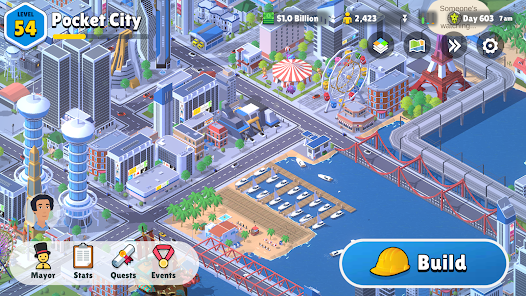
Because adjacent plots connect to your existing network, the cheapest expansion is always the one that touches what you have already built. A plot that shares a border with a working district needs almost no new infrastructure.
That single rule explains most of the difference between players who expand smoothly and players who keep running out of money.
On this page
When should you buy land?
When the districts you already have are full. A developed district is a tax base, and a full one is a signal that more space is needed rather than a reason to build something else on it.
Buying early feels like planning and behaves like debt. The land sits empty, the upkeep accrues, and by the time you build on it you have paid for several cycles of nothing.
There is one exception: buying a plot you will connect immediately, in the same session, as part of a district you have already planned. That is not anticipation, it is execution.
Everything else can wait. Land does not become more expensive over time, so there is no benefit to acquiring it before you can use it.
Which plots should you buy first?
The ones that extend your existing grid in a straight line. A plot that continues a road already built is nearly free to develop, because the road, the power and the water all extend naturally into it.
Plots that create a compact shape are second best. A roughly circular city is cheaper to serve than a long strip, because every service circle reaches more of the population from the same position.
Plots that touch nothing are the worst. They need a connecting road before anything else can happen, and that road is a cost with no tax base behind it until the district fills.
Water and terrain matter as well. A plot with awkward edges is harder to zone efficiently, and one that requires a bridge or a long detour may never repay its connection cost.
How do you develop a new plot cheaply?
Extend the road from the nearest existing street rather than starting a new one. You get access to the whole city immediately, and the new district inherits the traffic pattern rather than creating a separate one.
Extend utilities at the same time. A power plant or water tower placed so its circle just reaches the new plot costs less than a new facility, and it avoids the overlap that wastes capacity.
Zone a small area first. A modest residential strip along the new road tells you quickly whether access and coverage are working, before you commit the whole plot.
Add services only when residents arrive. A police station built for a district that has not developed is upkeep without a tax base, which is the same mistake as buying land too early.
How much land should you own?
Enough for the next district, not the whole map. Owning more than you can develop is a permanent cost and a false sense of progress.
A useful test is whether you can describe what will be built on each plot you own. If a plot has no plan, it is probably early.
Owning less also keeps the city compact, which is an advantage in itself. Utilities cover more of a compact city, traffic is shorter, and services reach more residents.
The map is not the constraint in this game. Coverage, traffic and money are, and all three get harder as the area you own grows.
What are the common expansion mistakes?
Buying distant land because it looks attractive is the first. It needs a connecting road before it does anything, and that road is expensive relative to the plot.
Buying several plots at once is the second. Each one begins charging upkeep immediately, and the combined cost can turn a surplus into a deficit in a single session.
Expanding before the current district is full is the third. You end up with two half-developed districts instead of one working one, and both need services.
Forgetting utilities is the fourth. New land without power and water develops nothing, which looks like a land problem and is a coverage problem.
Expanding outward in a strip is the last. A long thin city needs more utilities and generates more traffic than a compact one of the same population.
One practical test before any purchase is to ask what the plot connects to. If the answer is a road you have already built and a utility circle that already reaches the edge, the plot is cheap to develop. If the answer involves building a road first, the plot is considerably more expensive than its price suggests.
It also helps to buy in the direction your growth is already heading rather than in the direction that looks prettiest on the map.
Frequently asked questions
Does owned land cost money?
Yes. Upkeep applies to land you own, which is why buying before you can build is a net loss.
Can I sell land?
Expansion is generally a commitment. Plan the purchase rather than treating it as reversible.
Should I expand in one direction?
It is usually better to expand around your existing city so the shape stays compact and services keep reaching the edges.
Why is my new district not developing?
Usually no road connection or no utility coverage. Both are needed before anything appears.
How much land do I need for a working city?
Less than most players buy. A compact city with good coverage beats a large one with gaps.
For the zoning step that follows, read how to zone a new city, or return to the Pocket City 2 hub.
Official game information: pocketcitygame.com.