This guide covers tsuki odyssey how to decorate the treehouse with practical steps for mobile players.
Quick answer: decorating the treehouse in Tsuki Odyssey is mostly about working room by room rather than filling everything at once. Pick a room, decide what it is for, and buy items that suit it. Carrots come from your farm and activities, so decorating is a slow process rather than a shopping spree, and the treehouse looks best when each space has its own purpose.
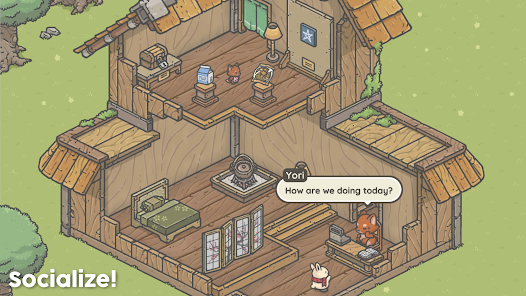
The treehouse is the centre of the game. It is where Tsuki lives, where your decorations go, and where most of the items you collect end up.
Understanding that it is a home rather than a display is the key to decorating it well. You are furnishing a place someone lives in, not filling a gallery.

Where should you start?
With one room. Choose the space you see most often, usually the main living area, and furnish it before moving on.
That gives you a finished room early, which is more satisfying than four half-decorated spaces.
It also teaches you how the shop works and what things cost before you commit carrots across the whole house.
Starting with the main room is the safest choice because everything else can follow its style.
Once that room feels right, the others become easier to plan.
There is a practical reason to start small beyond the satisfaction. Carrots are limited, and a player who spreads them across four rooms ends up with four rooms that each look half-finished.
A single complete room also gives you a reference point. When you move to the next space, you already know what your palette looks like in practice rather than in theory.
That reference saves you from buying things that seemed right in the shop and look wrong at home.
Most good treehouses were built one room at a time.
On this page
How do you decide what a room is for?
Give each room a purpose. A bedroom, a study, a place to sit and look out. Purpose makes every buying decision easier.
Without a purpose you end up buying things you like individually and finding they do not fit together.
Purpose also tells you when a room is finished, which prevents endless fiddling.
Write it down if it helps. A single sentence per room is enough.
The rooms that feel best in this game are almost always the ones with an obvious function.
It is worth noticing how much this simplifies shopping. Instead of browsing everything the shop offers, you are looking for one specific kind of thing.
That narrows the decision and makes it much easier to walk away empty-handed when nothing fits.
Purpose is what turns a shop full of options into a manageable list.
Players who feel overwhelmed by the catalogue usually have not decided what they are furnishing yet.
Should you match styles?
Within a room, yes. Across the house, keep them related rather than identical.
A house where every room is a different style reads as disjointed, while one where rooms share a palette and vary in intensity reads as designed.
Pick two or three tones and use them throughout.
That gives coherence without making the place monotonous.
If you find an item you love that does not fit, save it for the room it belongs in.
How do you afford decorations?
Carrots come from your farm and from activities, and they arrive slowly. Decorating is therefore a long project rather than a single purchase.
Buy one or two things per session rather than saving for a large haul. Steady progress keeps the treehouse changing.
It also means you live with each purchase for a while, which helps you judge whether it works.
Saving for a big item is fine occasionally, but do not let it stall the whole project.
Slow accumulation is the intended pace and it suits the game.
What about wall decorations?
They are the cheapest way to make a room feel finished. A bare wall makes even a well-furnished room look incomplete.
Start with one piece per wall and add if the space allows.
Wall items also cost less than furniture, which makes them good value when carrots are short.
They are the first thing to buy in a new room, before the larger pieces.
A room with walls sorted reads as cared for even if the furniture is modest.
What are the common decorating mistakes?
Filling every room at once. Buying without a plan. Ignoring walls. Changing everything constantly. And spending carrots on things that do not fit anywhere.
The underlying mistake is treating decoration as a shopping activity rather than as a design one.
If you want a rule, finish one room completely before starting another.
That single habit produces a treehouse that looks intentional rather than accumulated.
The most common mistake is decorating the treehouse as a single room rather than a set of small areas. Each corner reads better when it has one clear purpose, and a visitor notices a tidy corner far more than a well-chosen item lost in a cluttered room.
It also helps to leave floor space deliberately. A room with a gap in it feels lived in, while one filled to the edges feels like storage, and the game rewards the first impression rather than the item count.
Finally, swap pieces rather than adding them. New furniture arrives steadily, and replacing one item keeps a room readable where stacking three would not.
Frequently asked questions
Should you decorate every room at once?
No. Finish one room before starting the next.
Do wall decorations matter?
Yes. Bare walls make a room look unfinished regardless of the furniture.
Should rooms match?
Keep them related rather than identical, sharing a palette across the house.
How do you get more carrots?
From your farm and daily activities. Decorating is paced around that income.
Can you undo a decoration?
You can move and rearrange items freely, so there is no risk in experimenting.
Start with one room, give it a purpose, and finish it before moving on. You can also start from the Tsuki Odyssey hub.
Official game information: hyperbeard.com.