This guide covers monument valley 2 beginner guide with practical steps for mobile players.
Quick answer: Monument Valley 2 is a premium, single-purchase puzzle game about guiding a mother and her child through architecture that only makes sense from one viewing angle. You tap to walk, drag to rotate structures, and align impossible geometry until a path connects. There is no timer, no fail state and no energy system, so the correct approach is slow observation rather than fast tapping: look at what the camera sees, not at what the building would be in three dimensions.
It is a short, complete game rather than a service. You buy it, you play it, you finish it, and nothing in it ever asks you for another payment. That design decision shapes everything about how it plays: without a monetisation loop to feed, the game is free to be gentle, wordless and paced like a story rather than a challenge treadmill.
The story is told without dialogue. A mother and daughter travel through a series of monuments, and the emotional arc is carried by the architecture and the way the two characters separate and reunite. Understanding that framing helps, because it explains why some chapters feel like puzzles and others feel like scenes.

What kind of game is Monument Valley 2?
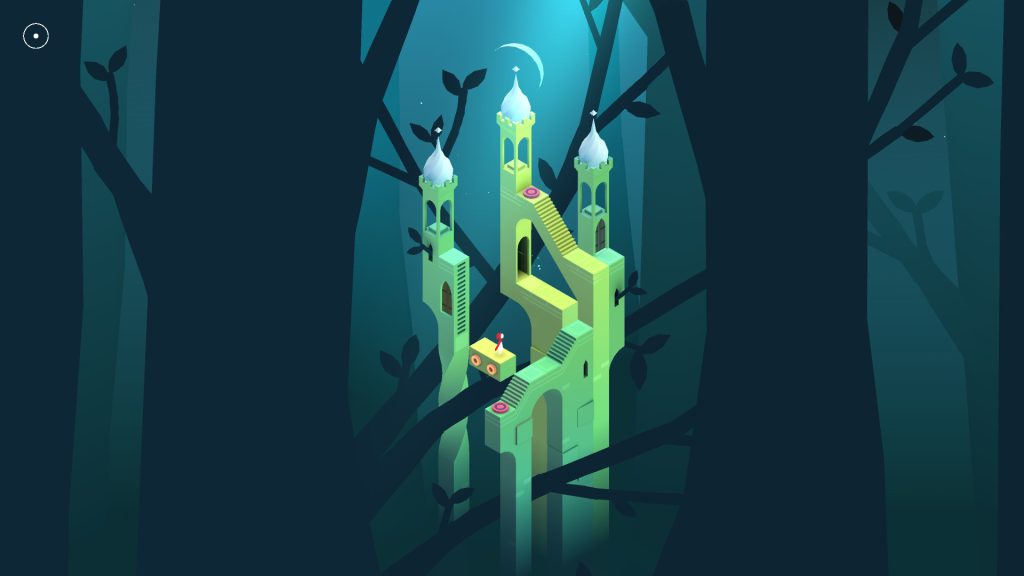
It is a perspective puzzle game, the sequel to the 2014 original. Each chapter is a small diorama built from impossible geometry, and your job is to find the route through it by moving the architecture rather than by solving maths.
The puzzles are spatial rather than logical. There are no switches to combine, no inventories and no dialogue choices. What you manipulate is the building itself: rotating a wheel, sliding a platform, turning a tower so that a staircase lines up with a bridge that should not reach it.
The result is closer to a walkthrough of a painting than to a conventional puzzle. Most solutions feel obvious once you see them and invisible until you do, which is why the game is about looking rather than about trying things quickly.
Structurally the game is a sequence of self-contained chapters. Each one is a single diorama with a beginning, a middle and an end, and progress is linear: finishing a chapter unlocks the next one. There is no hub world, no map to explore and no branching path, which means you can never get lost or waste a session wandering.
That linearity is a deliberate trade. It removes the freedom that a larger puzzle game offers, and in exchange it guarantees that every scene is exactly as difficult as the designer intended at that moment. You are being guided through a sequence of ideas rather than dropped into a sandbox, and the pacing reflects that.
On this page
How do the controls work on a touchscreen?
Everything is one finger. You tap a point on a path and the character walks there if the route is connected. You drag on a rotatable element and it turns. You drag a slider and a platform moves along its track.
There is no virtual joystick, no buttons and no gesture vocabulary to learn. The game teaches each interaction by placing it in front of you at the moment it is needed, and it never introduces a control that a later puzzle does not use.
On a phone the game is comfortable in portrait or landscape depending on the chapter, and the touch targets are generous. The one habit worth building is dragging slowly: rotation snaps into place, and a slow drag lets you see the moment a path lines up.
What is the perspective illusion actually doing?
The buildings are drawn in an isometric projection, which means you see them from a fixed angle and the game decides what connects. Two staircases at different heights can share a step if the projection makes them touch on screen, and the character will walk from one to the other as though the height difference did not exist.
That is the central trick, and it is not a glitch. The architecture is designed so that the flat image is consistent while the implied three-dimensional object is not. Your eye accepts the picture and rejects the object, and the puzzle asks you to trust the picture.
Once you internalise that, the game gets much easier. You stop asking where a staircase physically leads and start asking where it appears to lead, which is the only question the game ever poses.
How long does it take and can you fail?
It is a short game. A first playthrough takes an afternoon rather than a week, and that length is deliberate: each chapter introduces one idea, uses it two or three times, and ends before it becomes repetitive. Nothing is padded to extend play time.
You cannot fail. There are no timers, no hazards, no enemies and no way to lose progress. Tapping a wrong destination simply does not move the character, and any rotation can be undone by rotating back.
That absence of pressure is the point rather than a concession. Because nothing punishes you, you are free to experiment with the architecture, and experimenting is how these puzzles are actually solved. The game is designed around curiosity rather than around risk.
How should you approach a puzzle you are stuck on?
First, stop tapping and rotate something. Most stuck moments happen because the player keeps trying to walk a route that does not exist yet, when the missing step is a piece of the building that has not been turned.
Second, look for the gap. Trace the path from the character forward and find the exact point where it stops being continuous. That discontinuity is the puzzle: something near it needs to move so the two ends meet on screen.
Third, work backwards from the exit. The goal is usually visible, and the last few steps before it tell you which part of the structure has to line up. Solving the end of the route often makes the beginning obvious.
Is there anything to collect or unlock?
Not in the way most mobile games use those words. There are no coins, no stars, no chests and no upgrade currency. The reward for finishing a chapter is the next chapter, and the reward for finishing the game is the ending.
What the game does offer is optional observation. Some chapters hide small interactions or alternate routes that are not required to progress, and noticing them is its own reward rather than a checklist item.
That restraint is why the game holds up on a second playthrough. Without collectibles to hoover up, a replay is purely about the architecture, and you notice design decisions you walked past the first time.
The design decisions you notice on a replay are almost all about guidance. Nothing is labelled, so the game has to make the correct path look inviting and the wrong one look like scenery. Once you know the solution, you can see how deliberately the camera angle and the colour of each surface were chosen to steer you without a single word.
Audio carries more of the story than it first appears to. The music shifts when a chapter changes mood, and the ambient sounds sit where the characters are rather than where the camera is. Playing with headphones changes the experience more than it does in most mobile puzzlers, because the sound is doing narrative work that the visuals deliberately leave out.
There is no fail state anywhere in the game, and no timer, which makes it unusually easy to recommend to someone who does not normally play puzzles. You cannot get stuck in a way that requires a restart, you cannot lose progress, and you cannot be punished for experimenting. The only cost of a wrong move is the second it takes to undo it.
On the question of the paid chapters, the honest answer is that the game is short and the chapters are the content. If you enjoy the first few, the rest are more of the same at the same quality rather than a difficulty spike or a change of formula, so the decision is about whether you want more of this specific thing rather than whether the later chapters are better.
One thing worth knowing before you start is that the chapters are not arranged by difficulty in the way a typical puzzle game arranges them. They escalate in visual complexity rather than in logical difficulty, so a chapter that looks busier is not necessarily one that will take longer to solve. Judge each one on its own instead of expecting the curve to rise steadily.
It also helps to play in short sessions. The puzzles are short enough that fatigue rather than difficulty is the usual reason people get stuck, and stepping away for ten minutes does more for a blocked chapter than staring at it for the same amount of time.
Frequently asked questions
Do I need to play the first Monument Valley?
No. The stories are separate and the mechanics are taught from scratch, so this works as an entry point.
Is it suitable for children?
Yes. There is no violence, no text to read and no way to fail, which makes it unusually friendly to younger players.
Does it work offline?
Yes. It is a self-contained game, so it plays without a connection once installed.
Are there in-app purchases?
No. It is a single purchase, and nothing inside the game asks for more money.
Is there a hint system?
Not a formal one. The puzzles are designed so that the geometry itself directs you, and rotating the structure is the closest thing to a hint.
For chapter-by-chapter help, see the walkthroughs in the Monument Valley 2 hub, and for the mechanics behind the illusions, the guide to impossible paths.
Official game information: www.monumentvalleygame.com.