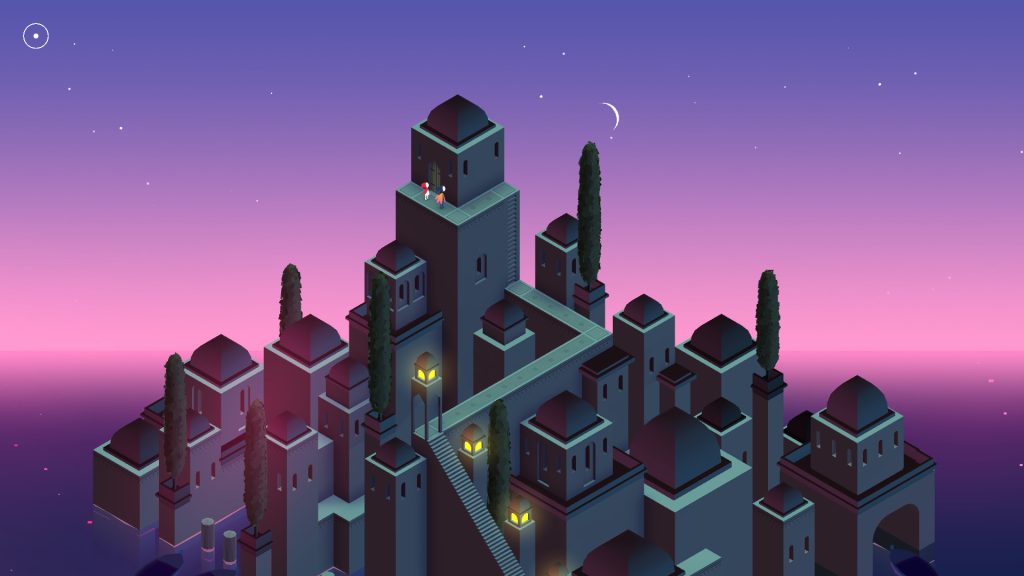
This guide covers monument valley 2 chapter 13 walkthrough with practical steps for mobile players.
Quick answer: Chapter 13 is a late puzzle that leans on the perspective illusion more than on mechanisms, so progress comes from lining surfaces up on screen rather than from finding a hidden wheel. Rotate to change the picture, walk the moment the path is continuous, and accept that some of the connections will look physically impossible. If a route seems to float, it is supposed to.
The penultimate chapters tend to step back from dense mechanism chains and return to the game’s original idea: architecture that only makes sense from one angle. This chapter is a reminder of that, and it asks you to trust the image rather than the structure behind it.

What is the chapter actually testing?
Your ability to read the projection. Two surfaces at different heights can connect if they meet on screen, and this chapter builds its route out of exactly those connections, with relatively few rotating or sliding parts to arrange.
That shifts the difficulty. Instead of managing several mechanisms, you are looking carefully at a single structure and noticing where the picture allows a path that the geometry would not.
Players who have been solving the late chapters by dependency order sometimes find this harder, because there is not much to sequence. The skill here is observation, and the answer usually appears all at once rather than incrementally.
On this page
How do you spot an impossible connection?
Look for two surfaces that appear to meet at an edge or a corner. In an isometric drawing, a wall and a floor can share a line on screen while being far apart in the implied building, and the game treats that shared line as a connection.
Then check whether the path runs continuously from the character to that join. If it does, walking is possible, and the character will cross a height difference that the picture implies is real.
The giveaway is often a stair that meets a roof, or a bridge that ends at a wall. If the join looks wrong to your eye, it is probably the intended route, because the game uses the visual contradiction as the signal.
Why does the route sometimes require a rotation to become visible?
Because the join only exists from certain orientations. Rotating a piece changes which edges align on screen, so a connection that is invisible now can appear after a quarter turn without anything about the mechanism changing.
That is different from the earlier chapters, where rotation moved a surface into place. Here rotation changes the picture, and the picture is what determines the route, so the same physical arrangement can be walkable or not depending on how it is presented.
The practical approach is to rotate slowly and watch the joins rather than the pieces. The moment two edges line up is the moment the route exists, and it is easy to turn past it.
How should you walk a route built from illusions?
One tap at a time, checking after each step. A route made of perspective joins can break partway along if a later rotation changes the picture, so walking in short segments keeps you from stranding the character mid-crossing.
If a step fails, do not assume the join is wrong. Look at the segment before it; a broken connection earlier in the route often shows up as a refusal several steps later, because the path is only continuous as a whole.
And keep an eye on the character’s height. In these chapters the vertical position is the clearest indicator of whether you have crossed a join or merely walked up to it.
What are the common mistakes in an illusion chapter?
Distrusting the picture is the first. Players who reason about what the building must be like physically dismiss the very connections the chapter is built on, and then conclude the puzzle is broken.
Rotating too fast is the second. The joins appear and disappear within a small arc, and a quick drag skips straight past the alignment you needed.
The third is looking for mechanisms that are not there. This chapter has few moving parts, so time spent hunting for a hidden wheel is time not spent reading the geometry in front of you.
How does this prepare you for the last chapter?
It restates the rule that makes the whole game work: the projected image is the world, and physical consistency is not required. The final chapter assumes you have internalised that and builds on it without explanation.
It also gives you a rest from mechanism management. After several dense chapters, a scene that is mostly observation is a change of pace, and it puts you in the right frame of mind for the ending, which is more about atmosphere than about difficulty.
So treat this chapter as a reminder rather than a test. If you find yourself overthinking the structure, stop and look at the screen instead.
The other thing to watch for is a join that only appears when the character stands in a particular place. Some structures hide a connection behind their own geometry, and walking a few steps changes which edges are visible. If a route seems to stop for no reason, move the character before concluding the puzzle is unsolvable, because the missing connection may simply be occluded.
None of this requires speed. The joins stay where they are, the rotation holds its angle, and the only thing that decays while you think is your own patience.
If you are stuck for more than a minute, stop rotating and trace the route from the character with your eye, join by join. Illusion chapters are almost always solved by looking rather than by acting, and the answer usually appears while you are doing nothing at all.
Frequently asked questions
Why can the character walk up a wall?
Because the surfaces meet in the projected image. The game connects what the picture connects, not what the building would be.
Are there hidden mechanisms in this chapter?
Few. It is built around the perspective illusion, so most of the work is visual rather than mechanical.
Why does a connection disappear when I rotate?
Rotation changes which edges align on screen. The route depends on that alignment, not on the pieces themselves.
Should I walk in one long tap?
No. Walk in short segments so a break in the route does not strand the character mid-crossing.
Is this chapter optional?
No. It is part of the main sequence and must be completed to reach the ending.
Next: the chapter 14 walkthrough, or return to the Monument Valley 2 hub.
Official game information: www.monumentvalleygame.com.