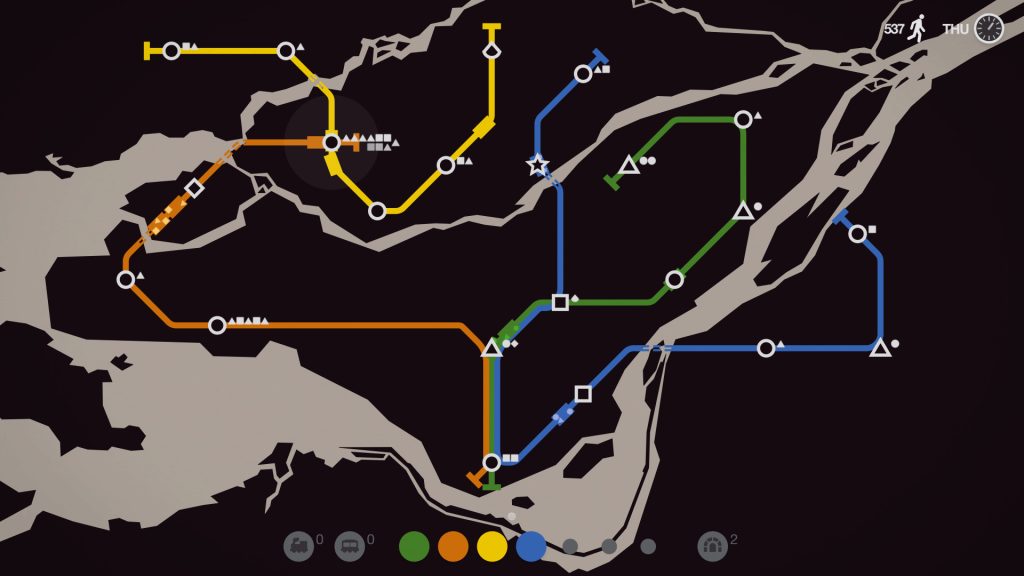
This guide covers mini metro vs mini motorways with practical steps for mobile players.
Quick answer: Mini Metro and Mini Motorways come from the same design lineage and feel immediately familiar, but they test different geometry. Mini Metro is about drawing lines between fixed stations, while Mini Motorways is about building roads between houses and destinations that move. Choose Mini Metro for a cleaner, more abstract puzzle and Mini Motorways if you want the same pressure with more spatial freedom.
They also share a refusal to explain themselves. Both expect you to learn by failing, which is part of the appeal.
What do the two games share?
Both are minimalist management games built around a single map that grows over time, with pressure that escalates until the network fails.
Both use the same upgrade structure, offering a choice between resources rather than a fixed progression tree.
Both are calm in tone, with no combat, no narrative, and no time limit on your decisions beyond the pressure of the network itself.
And both end the same way: a station or destination exceeds its capacity and the run finishes.
That shared skeleton is why the comparison is worth making rather than treating them as separate games.
They are variations on one idea.
It also changes how you fix a problem. In Metro you reroute a line; in Motorways you often have to rebuild a junction.
That makes Motorways more forgiving of small errors and more punishing of structural ones.
On this page
What is the core mechanical difference?
In Mini Metro, the stations are fixed and you decide which ones to connect. The lines are the variable, and the geography is the constraint.
In Mini Motorways, the houses and destinations are fixed but roads can branch, merge, and curve in ways metro lines cannot.
That gives Motorways more spatial freedom and more ways to make a mistake. A badly shaped road network is harder to diagnose than a badly routed line.
Metro is therefore the more abstract and the more readable of the two.
Motorways is the more expressive and the more fiddly.
| Factor | Mini Metro | Mini Motorways |
|---|---|---|
| What you draw | Lines between stations | Roads between buildings |
| Geometry | Constrained, readable | Free-form, fiddly |
| Failure clarity | High | Moderate |
| Escalation | Steady | Steady, sometimes sharper |
| Feel | Abstract puzzle | Spatial puzzle |
Watch how quickly you can explain a failure to yourself. If you can say why in one sentence, the game is teaching you well.
Metro passes that test almost every run. Motorways sometimes leaves you guessing.
Which is easier to learn?
Mini Metro. The rules are visible in the first minute, and a failed run tells you exactly which station overflowed.
Mini Motorways has the same clarity of goal but a muddier diagnosis, because a traffic jam can be caused by a road three junctions away.
That makes Metro the better introduction to the style.
It also makes it the better game to return to after a break, since you can rebuild the mental model quickly.
Motorways rewards familiarity more, and punishes absence.
Depth also shows in how long it takes to feel competent. Both take a while, but the ceiling differs.
Motorways has a higher ceiling because there is more space to optimise.
Which has more depth?
Mini Motorways, in the sense that there is more to get wrong and more to optimise. Road layout has more degrees of freedom than line routing.
Mini Metro’s depth is in reading demand rather than in construction. The skill is knowing which station will fail next, not in building an elaborate network.
That makes Metro the purer puzzle and Motorways the richer simulation.
Which counts as depth depends on what you enjoy.
Neither is obviously superior, and most players have a clear preference.
Consider whether you prefer learning many maps or mastering one. That preference decides between them more than any feature list.
Both are valid, and neither is a lesser way to play.
Which holds attention longer?
Both are designed for repeated short runs, and both rely on the same loop of attempt, fail, understand, repeat.
Metro’s maps are more distinct from one another, because each city’s geography creates a specific problem.
Motorways’ maps vary too, but the freedom of road building makes the differences feel less pronounced.
That gives Metro a slight edge in long-term variety.
Motorways has the edge in replaying a single map to solve it better.
If you are buying for a commute, Metro is the safer pick, since its runs are shorter and its failures quicker to understand.
If you are buying for an evening, Motorways gives you more to chew on.
Which should you choose?
Choose Mini Metro if you want the cleaner, more legible puzzle and the better introduction to the style.
Choose Mini Motorways if you have played Metro and want more spatial freedom and a harder diagnostic challenge.
Owning both is reasonable, because they occupy the same mood without duplicating the experience.
If you only play one, start with Metro.
It is the clearer statement of the design idea, and the other is a variation on it.
The two games are close enough that most players end up with both eventually, which is the honest recommendation.
Frequently asked questions
Are they by the same developer?
Yes, they share a design lineage and a visual language.
Which is harder?
Mini Motorways, generally, because road layouts are harder to diagnose than line routes.
Which is better for beginners?
Mini Metro. Its failures are clearer and its rules more visible.
Do they have the same upgrade system?
Broadly yes. Both offer choices between resources as the run progresses.
Can I play both?
Yes, and they complement each other rather than competing.
For the original game, see the Mini Metro hub.
Official game information: dinopoloclub.com.