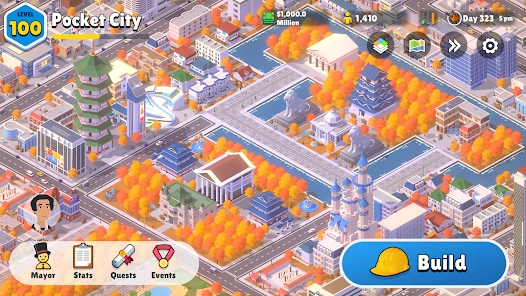
This guide covers pocket city 2 how to manage disasters with practical steps for mobile players.
Quick answer: To manage disasters in Pocket City 2, keep fire and police coverage complete rather than partial, and respond to an incident by sending the nearest service rather than by rebuilding the area afterwards. Disasters are cheaper to prevent than to repair, so coverage that reaches every block is the real defence. A city with gaps in its service radii will always lose buildings it did not need to lose.
Disasters are the game’s way of reminding you that a city has failure modes. They are not frequent, they are not random punishments, and they are almost always traceable to a coverage gap you could have closed.
What kinds of incidents happen?
Fires are the common one, and crime is the other. Both follow the same logic: a building inside a service radius gets a fast response, and a building outside it does not.
The consequences differ. A fire destroys the building and can spread to its neighbours, while crime reduces happiness and damages the district’s appeal without necessarily destroying anything.
Both are worse in dense areas, because the same radius covers more buildings and an incident that is not contained reaches more of them.
There is no way to prevent incidents entirely. The goal is to keep them small, which is a coverage question rather than a luck question.
On this page
How does coverage reduce the damage?
A fire station and a police station each have a radius, and buildings inside it get a response. Buildings outside it wait, and waiting is what turns an incident into a loss.
That means the useful measure is not how many stations you own but whether their circles touch every part of your built-up area. Overlapping coverage in one district while another has none is the pattern that produces avoidable losses.
Gaps appear at the edges as the city grows. A district that was fully covered at half its size often has an outer block or two outside the radius, and those blocks are where incidents go badly.
Checking the edges is therefore the maintenance task. Walk the boundary of your built area periodically and confirm the circles still reach it.
What should you do during an incident?
Respond with the service rather than watching. The game gives you the tools to act, and acting shortens the event.
Then look at what is around the affected building. If it is next to dense housing, the priority is containment; if it is isolated, the loss is smaller and the response can be routine.
Rebuild afterwards with the same zone type. Clearing and rezoning is usually faster than trying to restore a specific building, and the district recovers its shape rather than gaining a hole.
Note where it happened. A cluster of incidents in one area is a coverage problem, and that is worth fixing before the next one arrives.
How do you prepare before anything happens?
Build the first fire station as soon as the first district is developed. It is a small cost compared with losing several buildings, and it is the cheapest insurance in the game.
Add police coverage once the population grows, because crime becomes more likely as the city gets denser. The two services do not substitute for each other.
Keep a cash reserve. A city with no buffer has to choose between rebuilding and expanding, and that choice is worse than the reserve would have been.
And keep the service radii tidy. Moving one station a few tiles so its circle covers a gap costs nothing and prevents the incident you would otherwise have to respond to.
How do disasters interact with the rest of the city?
They punish density without coverage. A compact city is efficient to serve, but only if you actually place the stations; a compact city with gaps loses more per incident than a spread one.
They also punish neglect of the edges. The blocks at the boundary of your built area are the ones most likely to be outside coverage and the ones least likely to be noticed.
And they interact with happiness. Crime reduces it, which reduces population, which reduces the tax base you need to rebuild.
None of this is severe enough to end a run. The game is forgiving, and a lost building is an inconvenience rather than a crisis.
What are the common disaster mistakes?
Having no fire coverage at all is the first, and it is surprisingly common because the station is easy to postpone while you spend on growth.
Overlapping stations in the centre while the edges are bare is the second. It looks like good coverage on the map and it leaves the boundary exposed.
Ignoring crime because nothing has been destroyed is the third. Crime does not need to destroy a building to make a district unhappy and stagnant.
Spending the reserve on expansion is the fourth. When an incident arrives, the city cannot rebuild without borrowing from somewhere else.
Not rebuilding is the last. An empty plot in a district that was working will eventually refill, but only if you rezone it.
There is a simple audit you can run in under a minute. Look at your built-up area and trace its outline, then check whether the fire and police circles reach that outline everywhere. The blocks that fail the check are the ones that will cost you a building later, and moving or adding a station now is far cheaper than rebuilding afterwards.
It also helps to keep the response paths clear. A station whose crew cannot reach a street because of a one-way layout or a blocked junction is effectively not covering it, even though the circle says otherwise.
Finally, treat a quiet period as an opportunity rather than as a sign that you are prepared. The absence of incidents usually means the city has not grown into its coverage gaps yet.
Frequently asked questions
Can disasters be turned off?
Sandbox mode removes the pressure of the economy, and normal play keeps incidents as part of the simulation.
Do fires spread?
They can affect neighbouring buildings, which is why response speed matters in dense districts.
Does crime destroy buildings?
It primarily damages happiness and the district’s appeal rather than destroying structures.
How many stations do I need?
Enough that the circles reach every built-up block. Overlap in one place while another is uncovered is the pattern to avoid.
Should I rebuild immediately?
Yes, by rezoning the plot. Leaving a hole in a working district slows its recovery.
For coverage placement in general, read how to place service buildings, or return to the Pocket City 2 hub.
Official game information: pocketcitygame.com.